From Noema Magazine, a look at ways of cutting down on noise pollution in cities. I live in a neighbourhood where the trains are so loud at night that I can’t sleep without a white noise machine—this isn’t the pleasant chug-chug of trains passing by, it’s the screeching brakes and slamming cars of a rail yard—and have become much more conscious of noise pollution in recent years.
Two examples that really stood out: Germany (and other parts of Europe) use a “quiet asphalt” that has more empty spaces in it, which reduces friction and noise from high-speed traffic. This asphalt is more expensive to maintain, but they’ve made the decision to prioritize a more liveable urban environment, so they extra cost is worth it. And similarly, at least some subways and trains in Japan use rubber wheels instead of steel—again, it costs more to maintain, but they feel it’s worth the cost.
I also appreciated that the article goes beyond talking about just reducing noise to talk about good sound. Silence isn’t the goal, it’s a space that feels alive and welcoming, but that also allows for human interaction and contemplation. Bird sounds, outside conversations that are loud enough to be aware of but quiet enough to remain in the background—once you remove the constant din of urban sounds, there’s room for a soundscape that’s lively and nourishing, instead of damaging.
Our urban environment is something we’ve built and it’s something we can improve. Efficiency has its benefits, but it’s also important to build a world where human comfort is at least a factor in what we’re building. As the article points out, noise pollution affects how we think, how we feel, and our actual physical health—not to mention its impact on the birds and other animals that can make a space feel so welcoming. It’s inspiring to see places where noise is more than just an afterthought.
Recent instrumental music that seemed worth highlighting. I’ve been getting into the habit of sharing sporadic soundtracks on Threads, and figured it’d be an idea to start compiling them here, too.
Tuulikki Bartosik – Playscapes (2023)
Neo-classical accordion with harmonium, omnichord, and zither. More than a gimmick, the unconventional instrumentation gives this one a real sense of warmth. A very engaging combination of style & timbre, somewhere between Nils Frahm, Terry Riley, and Penguin Cafe.
Frank Horvat – A Village of Landscapes (2023)
A song cycle for bassoon (with piano, synths, and solo) inspired by Canada’s landscape, performed by Sebastien Malette and Allison Wiebe. I’m a sucker for music inspired by natural spaces, and these compositions have a very appropriate mix of tranquility, grandeur, darkness, and beauty. Bassoon isn’t what I’ve typically thought of as a feature instrument, but there’s no denying its versatility.
Felbm – Cycli Infini (2023)
Kicking myself for not including this low-key masterpiece on my year end list. Blame the format—a single 40-minute track is harder to fit into my normal listening habits—not any lack in the composition. A single bedroom jazz journey built from tape loops large and small, softly spiraling into infinity, each moment complete in itself and also subsumed in those around it.
Fabiano do Nascimento & Sam Gendel – The Room (2024)
An album of captivating duets—do Nascimento on seven-string guitar and Gendel on soprano sax—up there with the best of Brazillian jazz. The musicianship is stellar but never loses sight of melody and mood. Released less than a month into 2024, and setting a very high bar for the rest of the year to meet.
On the one hand it’s certainly fun watching a self-proclaimed hedonist destroyed by a woman who genuinely doesn’t care about the rules of polite society, and the way supposedly intelligent men fall in love with a mental six-year-old is obviously meant to be stinging. But I can’t shake the feeling that this is a very masculine take on female liberation, especially in its fascination with sexuality to the exclusion of almost everything else. Bella is a cipher for most of the film, more defined by her effect on others than by her own inner life. Her alternative to the possessiveness of men is pure callousness verging on intentional cruelty. She’s a spin on the magic pixie dream girl, but less a subversion than a caricature.
Except when she isn’t, and maybe that’s part of showing someone essentially inventing themself, and pushing against social limits in the process. You can’t be fully developed and a work in process at the same time. So sometimes she’s a male fantasy or a nightmare, others she’s a real person trying to understand her past and define her future.
Anyway, it’s impressive to see what a stylist Lanthimos has become here. The performances are mostly sharp, and the production design and costuming deserve all the awards they’re bound to get. This is vivid, imaginative, and fun, but it does leave me feeling conflicted.
Hero’s journey, blow up the Death Star with the Force space fantasy with a bit of hand-wavey political subtext for good measure. I’m glad that a non-franchise story can get told on this scale, but if I’d realize I was getting into a 2.25-hour set of military skirmishes with shades of Eastern mysticism thrown in as set-dressing, I would’ve just accepted it as “not my thing” and moved along. There’s not nearly enough time spent establishing the relationship that’s meant to anchor the story, so it relies on indistinguishable action sequences and mawkish sentimentality for interest and gravitas respectively, and I found neither to be all that effective. I know others who enjoyed it, but aside from the visuals I found it quite dull.
Our choice for first movie of 2024 was between this and a cult post-apocalyptic Aussie action film, and this was definitely the better choice. Sharp, fun, and genuine. Even with the title I didn’t realize how much religion would play into this, but even that is handled deftly. Good stuff.
I saw another review on Letterboxd that said this movie takes a fantastic premise and then takes the least interesting route at every opportunity. That’s overly harsh, but it’s not totally unfair, either. At a certain point, the movie drifts from being about a character responding to an absurd situation, to being about cancel culture and fame and the strokes just keep getting more and more broad. It gives way to a pretty rote downward spiral, which is disappointing given the odd but engaging specificity of the early scenes.
That said, I will always enjoy watching Tim Meadows doing his thing. I don’t know what it is exactly, but he’s just such a steady presence. He’s never let me down.
Travis starts the film as someone who doesn’t want to be saved, and ends it as someone who probably doesn’t deserve to be—he aims for understanding instead of atonement, and while he seems to recognize that he’s still a destructive force (hence the desire to disappear again), he doesn’t see that even his better intentions are still selfish and poorly thought through.
It’s tough, because Stanton is so likeable, and what Travis has done is so horrific. I want him to do better, or to be punished but it’s neither: he emerges from purgatory and then goes back to it, stuck in a stasis with nothing resolved. He runs from himself, puts himself in a place with no language and no memory, and leaves everyone else with the challenge of functioning and rebuilding and carrying on.
The ’90s were pretty great for getting a bunch of fantastic character actors, a weirdo director, picking an underappreciated genre, and just going for it. I don’t know for sure that this got greenlit after Pulp Fiction became a smash, but it really feels like it’s of that era where no one quite knew what was going to work, so they took a bunch of swings just to see what would happen.
Gene Hackman is great as always, a pre-Titanic DiCaprio is somehow already mocking his pretty-boy image a year before Romeo + Juliet even came out, and even dang-ol’ Woody Strode makes a cameo. Raimi takes the close-up-on-the-eyes thing to ridiculous extremes. Lance Henriksen gets to play the least Lance Henriksen role I’ve ever seen and he eats it up. Russell Crowe is even almost likeable.
First of Wes Anderson’s Roald Dahl shorts that I’ve seen (we don’t have a Netflix subscription right now), and the tone is certainly something. Somewhere between storytime, children’s theatre, and student film, albeit with incredibly talented people handling all the details.
I almost would’ve preferred if the short hadn’t used a prop/animated rat at all—they were so committed to the bit of imaginary props that it was a bit of a letdown to drop it. Otherwise, I’m not really sure what to make of this. It’s a fun diversion, and it seems like that’s probably all they were going for, so… well done, I suppose.
Would never have guessed that this is ZAZ (directorial trio Zucker Abrams Zucker)—the sense of humour is completely different from your Airplanes and Police Squads and Hot Shots, much more grimy and mean and, well, Danny Devito-y, for lack of a better term. And I think it would’ve been better with someone like Devito at the helm really playing up those elements, because as it is, it’s directed a little more lighthearted than the plot and subject matter really call for. In other words, it’s not vicious enough for how vicious it is, if that makes sense.
But Bill Pullman is phenomenal in this, and they gave Sally Cruikshank some work on the opening credits, so I’m still all for it.
Something felt off in the scale of this. There’s such elaborate world building in its depiction of a massive city populated by elemental creatures; you just know someone has a 100-page bible outlining each Element’s architecture and cultural history and technological preferences. The story itself is relatively intimate and personal, but because the world is so elaborate, it feels like it’s is going to go bigger—there are recurring floods in the city that seem poised to open to some Chinatown-style conspiracy, or at least something that ties more deeply into the narrative—but it never does. It’s just there because the filmmakers needed a big set piece, even though the stakes of the smaller story would have been more than enough.
It would be fun to sell people on this Anthony Hopkins muderous puppet movie by saying “it’s from the author of the Princess Bride” just to see what happens.
The main character, a musician/ventriloquist named Corky, is more a Michael Moriarty character than a Hopkins one—my memory is already sort of swapping in Moriarty’s jazz musician from Q: The Winged Serpent into the role—but Hopkins really does give this his all. Ann Margret has to sell the idea that anyone would find this act charming enough to throw away your life, and does a decent job showing the desperation that would require. It stretches credulity more than a few times, but it’s effective all around.
I fully believe that Burgess Meredith’s aging agent would pitch a combination ventriloquist/magician act as the next big thing; less confident audiences would eat it up, but hey, I wasn’t alive in 1978 so what do I know. They reference Steve Martin and Rich Little and maybe they saw that as proof of a neo-vaudeville revival. So, sure.
Here it is: AM Gold 2023. 100 albums from 2023 that made the year a little more bearable. The list spans genres and continents, but all these selections fit the general AM aesthetic of chill vibes and musical invention. It’s a testament to how much good music comes out in a given year that 100 hardly seemed like enough, but, well, you have to draw a line somewhere. The playlist above has selections from all of the albums that are on Spotify, plus a handful of singles that were too good not to share, even if their albums didn’t quite make the list (clearly I am no good at drawing lines). Hope you enjoy them. PS – Apologies in advance for typos and repetitive writing—putting together 100 blurbs in a few days is a bit of a task.
Streliski composes solo piano pieces that are romantic in the historical sense, emphasizing emotion and imagination. Lovely and contemplative.
🍁 ALL HANDS_MAKE LIGHT – “Darling, The Dawn”
Droning experimental pop and shoegaze from Godspeed’s Efrim Manuel Menuck and La Force’s Ariel Engle; slow-moving walls of sound with surprising melody and much emotional heft.
Andrew Bird – Outside Problems It’s always a treat to hear Bird indulge his more unstructured side. These looping, freewheeling takes may be less polished than his pop work, but they’re joyful, spontaneous, and immersive.
April March & Staplin – April March Meets Staplin 30 years on from Chick Habit, March is still a master of utterly charming French pop and psych rock. With Staplin, she’s created some wonderfully gritty textures and upbeat melodies.
Baby Cool – Earthling on the Road to Self Love Breezy, coastal psychedelia, sometimes like a sunnier spin on the Brian Jonestown Massacre, others like the country side of the Byrds, all with an undercurrent of Aussie pop jangle.
Benoit Pioulard – Eidetic
Pioulard (AKA American musician and poet Thomas Meluch) is better known for his ambient works, but his folk-rock detours are always a highlight. Eidetic sees him at his most polished and structured, but still well served by his ear for atmosphere.
Blue Lake – Sun Arcs Acoustic kosmische that verges on drone in parts, but is at its strongest when it coalesces into more structured sounds, like the jazzy “Bloom” and acoustic opener “Dallas”.
🍁 Blume – Inner Vision A dense fog of hypnotic psychedelia and shoegaze, sprawling, droning, repetitive and engrossing in a way that only space-rock can pull off.
Brendan Eder Ensemble – Therapy A set of healing neo-classical (neo-age?) sounds for woodwind and horn, with a pair of unexpected Aphex Twin covers thrown in for good measure.
The Brights – Oyster Rock! Every year deserves a great laid-back jangle-pop record, and this year’s best comes courtesy of Sydney’s The Brights.
🍁 Bry Webb – Run With Me A welcome return for the former Constantine, and one run through with melody and sensitivity.
🍁 Buildings and Food – Infinity Plus One Electronic soundtracks for blank slates and infinite possibilities. The undercurrent of hope and optimism makes for a much-needed retreat.
The Clientele – I Am Not There Anymore Alasdair Maclean & co. always manage to stay on the right side of consistency—instantly identifiable, but still finding ways to expand and experiment.
Contagious Yawns – Intramental
Building beautifully on 2020’s Dream of Consciousness, Intramental mixes intriguing spoken-word samples, deliberate drum loops, and simple synths into something deceptively existential and endless.
Decisive Pink – Ticket to Fame Deradoorian and Kate NV teaming up to produce pop sounds that are quirky, mystical, satirical, and endlessly inventive
Early Fern – Perpetual Care Gentle, melodic ambient music and field recordings, a pleasant ramble through creeks and lakeshores in audio form.
Edena Gardens – Dens The latest permutation from the frighteningly prolific Jakob Skøtt and Martin Rude’s is a gentler spin on psych and space rock, nodding to the Durutti Column and Mark Hollis in its improvised odysseys.
Eluvium – (Whirring Marvels In) Consensus Reality Ambitious, extravagant, and uplifting, Matthew Robert Cooper has outdone himself on his most recent effort—a “whirring marvel” of cascading strings and slow-drifting compositions.
Ensemble 0 – Jojoni (Made to Measure, Vol. 49)
This international trio has found a unique voice mixing acoustic guitars and metallic percussion, influenced by cult composers like Arthur Lee and Moondog, but finding their own thematic and musical obsessions to mine.
Fabiano do Nascimento – Das Nuvens An immersive fusion of Brazilian guitar, beat-driven electronics and ambient jazz, on the always-excellent Leaving Records.
Faex Optim – Crystal Pleasures You can still hear the Boards of Canada influence that dominated Faex Optim’s early releases, but it’s expanded here into something clean, crisp, and more uptempo.
Faten Kanaan – Afterpoem Somehow sounds like it emerged from underground catacombs where strange creatures spend their days devoted to creating devotional music for unlikely cthonic gods. Haunting, possibly haunted, but also capturing something quite pure.
🍁 Freak Heat Waves – Mondo Tempo “In a Moment Divine” is the unmissable highlight, with Cindy Lee’s vocals lending the perfect degree of swoon to FHW’s dubby dancefloor productions.
Futuropaco – Fortezza di Vetro, Vol. 1 Instrumental psychedelic grooves that are tight, propulsive, and unpredictable—a suitable soundtrack for a futuristic ’70s space thriller, if you happen to be making one.
Gilroy Mere – Gilden Gate
What begins as a meditative stroll gradually becomes something more mystical, as rolling hillsides descend to the abandoned streets of an underwater city in Mere’s moving instrumental journey through Dunwich’s sunken landscape.
Golden Brown – Weird Choices An ambient-kosmische fusion of pedal steel and meandering keyboards, each channeling the cosmic in their own way.
Golden Ivy – Kammarn Instrumental compositions that straddle the line between folk and neoclassical on a bed of electronic impulses, gentle strings and breathy winds, alien and earthy at once.
Green-House – A Host for All Kinds of Life Joining the proud tradition of plant music that goes at least back to Mort Garson, Green-House’s ambient bliss reflects a search for joy and connection with the natural world.
🍁 High Five – Salad Balloon Improvised kosmische epics with slacker-rock and MPB undercurrents; sprawling and unpredictable and alive with the joy of creation.
🍁 Hollie Kenniff – We All Have Places That We Miss
Kenniff creates ambient music the old-fashioned way, with live instruments, heaps of reverb, and endless patience. Somewhere between dream-pop and drone, and among the most beautiful music of this type in recent memory.
Holy Wave – Five of Cups Hazy Texas psych enhanced by a pair of strong guest spots from Lorelle Meets the Obsolete, Estrella del Sol.
Huw Marc Mennett – Days Like Now An unplaceable and omnivorous instrumental blend of folk, jazz, and groovy psychedelia, global in range but filtered through traditional Welsh sounds.
Hynta – Hyperobjects Modular synths, field recordings, and ambient drones aiming to evoke concepts too big and too complex to fully comprehend.
The Ironsides – Changing Light Soundtrack soul with a cinematic sweep, a mix of library music, David Axelrod’s symphonic grandeur, and a bit of Daptone strut for good measure.
Ivan the Tolerable – Under Magnetic Mountain
It’s hard to pick a favourite of the five albums Ivan released in 2023 (four new, one reissued), but Under Magnetic Mountain is maybe the most impressive in its mix of psych, jazz, and radiophonic explorations, a deep heady stew of subterranean sound.
Jilk – Syrup House The strongest of three releases this year from a collective that prioritizes play and invention, creating more optimistic spin on early-2000s post-rock and electronics.
Josh Semans – To Will a Space Into Being One for the Erased Tapes fans—neo-classical in the vein of Nils Frahm and Olafur Arnalds, composed for the otherworldy soundscape of the Ondes Martinet.
🍁 Khotin – Release Spirit Chill beats to transcend to—an optimistic set of mostly instrumentals (and one vocal from Tess Roby), best experienced with the sun on your face and fresh air all around.
🍁 L.T. Leif – Come Back To Me, But Lightly A confidently inquisitive release from the Calgary ex-pat, lyrically rich and musically murky (in the best sort of way).
Lael Neale – Star Eaters Delight Neale makes excellent use of mythic and mystical imagery, layering shimmering Omnichord over deliciously droney Velvets jams.
Landing – Motionless I-VI
With over two decades spent refining their sound, this Connecticut quartet has pretty much perfected its pioneering take on ambient psychedelia, shoegaze and drone. Immersive and atmospheric.
Large Plants – The Thorn Rich, melodic prog-influenced psychedelia from the heart of the deepest woods. A folk-horror soundtrack in the making, albeit one with memorable riffs to spare.
Lonnie Holley – Oh Me Oh My The blend of atmospheric soul, Eno ambience, and oddball flourishes would be intriguing enough, but that voice! Worn and warm, and wise, resilient, reassuring, and defiant.
Lord of the Isles & Ellen Renton – My Noise is Nothing If the pairing of experimental synths and spoken-word poetry doesn’t sound immediately appealing, set your doubts aside for this one. An exploration of post-pandemic emotions, it’s as complex as it is comforting.
M. Sage – Paradise Crick A multifaceted, contemplative ambient release layered through with the sounds of nature—or synthetic approximations, blurring them to such an extent that it almost doesn’t matter which is which.
🍁 Marker Starling – Diamond Violence Masterful melodies, perfect pop instincts, and a cutting sense of playfulness from Canada’s answer to Gruff Rhys.
🍁 Markus Floats – Fourth Album
A noisy, unabashedly experimental, at times impenetrable mix of free jazz and electronic composition. It takes time to reveal itself, but when it does, the rewards are manifold.
Marlene Ribeiro – Toqui no Sol Avant-electronics drift into dream-pop bliss, immersive throughout but finding its peak in the graceful seven-minute slow-build that is “You Do It.”
Mary Lattimore – Goodbye, Hotel Arkada It’s undoubtedly a cliche to call harp-based music “shimmering” or “delicate,” but it’s still true of Lattimore’s gossamer sounds, so here we are.
🍁 Masahiro Takahashi – Humid Sun Envisioned as “an auditory tool to cope with [Toronto’s] harsh winters,” Takahashi’s Telephone Explosion debut is a warm bath of meandering synths, rubbery bass, and gently chugging drum machines.
Maya Ongaku – Approach to Anima
Gentle, jazzy, laid-back psychedelia on Kikagaku Moyo’s Guruguru Brain record label. The songs rarely raise a fuss, preferring to let the cosmic vibes speak for themselves.
Mega Bog – End of Everything Mega Bog abandon the winding guitars of 2021’s superb Life, And Another for a downright apocalyptic prog-pop album, an anxious, dour reflection on tragedies both personal and global.
Melenas – Ahora Lead single “Bang” sets a high standard, but Melenas’ songwriting is up to the challenge. Nostalgic, synth-driven garage-pop with hooks aplenty.
🍁 Michael Peter Olsen – Narrative of a Nervous System Multilayered electric cello that occasionally channels (and features) Owen Pallett, but the ambient impulses and noisy digressions are entirely Olsen’s.
Mike Reed – The Separatist Party The glistening keys and warm trumpet melodies of “Floating With an Intimate Stranger” are a perfect entry point, but it’s the subtle Afrobeat pulse, exuberant spoken-word vocals, and voyages into spiritual skronk that keep me coming back.
Misha Panfilov – In Focus Panfilov’s library jazz mastery is pure auditory sunshine. Unabashedly cheesy, but sophisticated enough to bear up to repeat listens.
ML Buch – Suntub Performed on a seven-string guitar in open tunings, Buch’s experimental sound channels the spirit of ’80s art-pop heroes like Kate Bush and XTC without anything like direct reference.
Modern Cosmology – What Will You Grow Now Stereolab’s Laetitia Sadier and Brasil’s Mombojó team up for an album of conceptual space-pop and psychedelia. Every bit as charming as you’d hope.
Modern Nature – No Fixed Point in Space After two albums pointing in this direction, Jack Cooper’s post-Ultimate Painting project fully embraces its spare, minimal approach to songwriting. Conjuring free jazz and evoking Mark Hollis’ solo work, this is music that is deeply personal, intimate and exploratory.
🍁 N Nao – L’eau et les rêves
Folk and dream pop elevated by atmospheric production and an endless arsenal of effects pedals; L’eau et les rêves refuses to settle into a fixed form, ebbing and flowing from song to song with a remarkable fluidity.
Nabihah Iqbal – Dreamer Nearly six years in the making (owing in part to a studio robbery in 2020), Iqbal’s latest was worth the wait, a confident fusion of dream pop’s moodiness and dancefloor euphoria.
Nashville Ambient Ensemble – Light and Space Ambient country is having a moment lately, with excellent releases from SUSS and North Americans, not to mention essentially everything on Aural Canyon, but Light and Space is the finest of the bunch, a twilit haze of pedal steel, violin, and glacial guitars, smothered in reverb and drifting into eternity.
🍁 Netrvnner – Phantom Calgary’s finest synth-wave artist embraces post-punk and the results are essentially perfection, atmospheric and energetic instrumentals that are at once retro-minded and full of vitality.
Nico Georis – Cloud Suites
Exactly what a concept album about clouds should sound like—impressionistic shapes briefly forming and drifting apart, weightless and immersive.
🍁 Ora Cogan – Formless Another leap forward for the musically restless Cogan, moving effortlessly from haunted folk to post-punk edge to cosmic Americana.
🍁 Peace Flag Ensemble – Astral Plains Spiritual jazz improvisations from the Canadian prairies, anchored in gentle piano and electric bass, striking a rare balance of melody and experimentation.
Pearl & The Oysters – Coast 2 Coast Sweet summer sounds from LA. Retrofuturistic indie-pop for fans of Stereolab (Laetitia Sadier makes an appearance), but replacing the motorik detours with crisp, concise pop hooks.
Pedro Ricardo – Soprem Bons Ventos Released in February, Ricardo’s debut was an early favourite and hasn’t released its grasp. A brilliant, enthralling blend of Portuguese folk, latin jazz, and experimental electronics.
Penguin Cafe – Rain Before Seven Joyous, infectious, and deceptively complex, Arthur Jeffes has hit his stride in his incarnation of his late father’s Penguin Cafe Orchestra project.
Rozi Plain – Prize It’s hard to pin down exactly what makes Rozi Plain’s idiosyncratic folk-pop so hypnotic, but there’s no denying the magic. It’s hopeful, warm, and unpredictable, a difficult feat in any genre and one Plain makes look effortless.
🍁 Ryan Bourne – Plant City
Often a secret weapon for others in the Calgary psych-rock scene, serving in Chad VanGaalen’s band and in Ghostkeeper, among others, Bourne rarely steps out on his own—his last solo release under his own name was in 2010. Plant City shows the delay isn’t due to an absence of ideas; its glammy, hook-laden songs span genres, laced through with cynicism, humour, and classic songcraft.
Salami Rose Joe Louis – Akousmatikous One of pop’s most inventive voices expands the conceptual worldbuilding of 2019’s Zdenka 2080 with more inimitable dream-jazz-soul-prog-psych bliss.
Saloli – Canyon A day in the life of a bear, rendered solely through a modular synth—live, not programmed—and a delay pedal.
Skyphone – Oscilla Sparse electroacoustic post-rock that evokes decaying landscapes and impossible architecture, a journey through ancient, overgrown alien ruins.
Slowdive – Everything is Alive The Slowdive comeback has no right to be this good. More than three decades after their debut, they’re in absolute top form on Everything is Alive, more vital, more inspired, and somehow less nostalgic than most shoegaze acts a quarter their age.
Spencer Cullum – Coin Collection 2 Cullum’s reedy voice and impeccable melodies recall Robert Wyatt, and so does his omnivorous musical taste. Coin Collection 2 is solidly grounded in pastoral ’60s-and-’70s folk-rock, but it’s the opposite of myopic, with tasteful flourishes and surprising moments around every corner.
Spencer Zhan – Statues II Zhan’s three albums this year included a full-length cover of a Harry Styles album, and two sculptural ambient-jazz releases—all of them deserve an ear, but if you only have time for one, choose this.
🍁 Test Card – Channels Canada’s answer to the pastoral electronics that UK labels Ghost Box and Clay Pipe specialize in. Consider that high praise.
Tommy Guerrero – Amber of Memory
Guerrero describes this collection as “surf goth,” but there’s nothing bleak about it. Just swoon-worthy dream-pop instrumentals beaming sunshine into your darkest days.
Ulrika Spacek – Compact Trauma Leaning more towards post-punk than 2017’s shoegaze-influenced Modern English Decoration, and does it as well as anyone out there right now.
Unknown Mortal Orchestra – V Just a flawless lo-fi pop record, with impeccable guitar, a low-key but irresistible sense of groove, and a melancholy that adds salt to the sweetness. Wins me over more with every listen.
Veryan – Reflections in a Wilderness A chilly, crystalline ode to the beauty of frozen landscapes—which, in the middle of a Canadian winter, doubles as a reminder to find happiness where you are instead of wishing for escape.
Vic Mars – The Beacons In some ways, Mars’ pastoral folktronics are worlds away from his early educational-video-inspired releases, but the through-lines are there: the appreciation of melody, the ability to create complete worlds in a few short minutes, and the commitment to an aesthetic have all remained, and all serve Mars beautifully on his latest for Clay Pipe Records.
Violetta Vicci – Cavaglia A nostalgic, melancholy release from the UK composer, recollecting childhood summers and reflecting on the fragility of nature through swooning strings, ghostly vocals, and subtle analog synths.
Wax Machine – The Sky Unfurls, The Dance Goes On
Offering a more sophisticated spin on the tropical psychedelia of their earlier releases, Wax Machine’s latest is also by far its strongest. Spacious, dreamy, subtle and subdued.
Whatitdo Archive Group – Palace of a Thousand Sounds Like the Ironsides, Whatitdo Archive Group specialize in library grooves creating the kinds of sounds that would get crate diggers salivating if they’d been recorded in the ’70s and still should today. Hints of exotica and global influences, but the beat is always front and centre.
🍁 White Poppy – Sound of Blue Crystal Dorval specializes in the dreamiest of dream-pop songs. Her bio says it best: “Music for memory gardens and pastel horizons, dreaming of bliss and distance”
Y La Bamba – Lucha Warbly, off-kilter, Latin-influenced indie folk that isn’t afraid to undercut a pop hook with an experimental digression, and vice versa.
Yo La Tengo – This Stupid World Its got your noisy jams, your indie gems, your gentle ballads—YLT may be comfort food at this point, but who doesn’t need a bit of comfort? Especially in the face of all the everything thrown at us by, as the title says, this stupid world.
🍁 YOCTO – Zepta Supernova Sci-fi space rock from a supergroup of Quebec psych-rockers. Punky and energetic, virtuosic when it wants to be, and cool in that way that only half-spoken French vocals can be.
🍁 YouYourself&I – L’Amour des Anoures Intimate, intricate bedroom folk from Montreal, from an artist with 26 releases on bandcamp and shockingly little other info online.
Yussef Dayes – Black Classical Music
Strange how a first album can feel like a greatest hits. Dayes’ funk-soul-jazz debut is wide-ranging, soulful, accessible, and does not let up.
This new single from Victoria’s Loving brings their total number of releases to three—an EP in 2016, a full-length in 2020, and now this lone song, seemingly unconnected to any larger album. It’s a sparse catalogue but an immaculate one, and “Blue” has the same haziness that has made the rest of their music so intriguing. Unhurried, gentle, contemplative, and lovely. What more could you want? Aside from, well, more.
tags: weird horror, weird fiction, fantasy worlds, dark magic
I’m not sure whether it’s a story with a long digression in the middle, or a story with a long framing device bookending it, but either way an odd construction—a tale split in the middle by another story as long as the rest combined. That middle story is the more vivid one to me, the characters more fleshed out, the setting more vivid, and that sort of works given that the middle story is meant to be almost an infection, capable of carrying additional details even if they aren’t told.
The outer story drapes itself in the weight of loss, and I don’t know that it quite carries it. Those human elements aren’t what has stuck with me, at least. Not in the same way as the more fairy tale-like middle story, which spans generations and continents. That one is a story of duelling dark magicians, more compelling but I guess less weird than a lonely fisherman stumbling onto the fringes of that story. So what this really is, is a weird story that manages to explain itself without losing its impact.
Such a perfect fusion of weird horror and pulp and comic book tropes, with some of the most striking art that comics have produced. I don’t know why I’ve only ever read bits and pieces of Hellboy, I’ve known for ages that I would love it when I got around to it. Maybe it’s that there’s so much of it out there, but right now that’s what makes it so delightful to start on it.
It was the documentary Mike Mignola: Drawing Monsters that pushed me into finally sitting down to read a Hellboy collection. I’m usually pretty leery of art documentaries, but Drawing Monsters was one of the best I’ve seen in a long while. Mignola himself seems down-to-earth and self-depricating, and generally aware of his flaws, and it’s nice to find someone who managed to build a career around doing what he loves and recognizes how fortunate that is. Plus, the directors seemed like nice folks when I interviewed them last year for the CUFF.Docs documentary film fest.
This visual essay is based on a premise that doesn’t really hold true for me, in that I have never really felt that I “see” when I read. So when Mendelsund tries to convince me that “seeing” is a false impression that’s disconnected from the actual experience, I’m already there. If there’s a revelation to be had from that, it’s just that I thought other people with a stronger visual sense would have a different experience. Maybe not.
Outside of that, I definitely enjoyed Mendelsund’s flair for visual metaphor, and the book’s questioning of the experience of reading. It’s kind of amazing how much The Master and HIs Emissary is impacting everything else I read that comments on perception and phenomenology and philosophy of mind. Here, Mendelsund describes what we “see” of the characters and settings we read about as fragmented, detailed in parts but not additive—more details don’t create a more vivid image, even if they do create a more rounded understanding.
I kept thinking of the left-brained mode of perceiving, the one that dissects and strips of context, that knows the parts that make up a whole but can’t seem to understand how to put them together. Mendelsund isn’t using that framework, but everything he says fits the idea that literature and language more generally is the domain of the dissecting left brain.
tags: short stories, fairy tales, fantasy, magic, fairies
It doesn’t have the scope of Jonathan Strange & Mr. Norrell, and it doesn’t suggest the same depths as Piranesi* but Clarke is a delightful writer and these stories nicely flesh out her conception of fairies as a strange mix of sophisticated and feral. Decadent is probably the word for it—the characters, not the stories, which are modest enough and all have the feel, appropriately, of fairy tales for adults.
Charming as most of the stories are, the real treat was the brief return of Jonathan Strange. Funny how satisfying it can be to revisit a character in a more relaxed setting.
*Not exactly fair to compare, given that Piranesi is quite possibly my favourite piece of fiction in the last decade or so, just an absolutely magical work in every sense of the word.
Plenty of good anecdotes on the way companies use their position as dominent buyers or sellers to manipulate markets, pocket unfair shares of wealth, and generally make life worse for everyone who isn’t their execs and shareholders. The collective solutions proposed all seem like reasonable starting points, too—but while I agree with their point that systemic problems require systemic solutions, I don’t feel like I left the book with a starting point of how to work towards that change.
Maybe just naming the problem and talking about it is a sound enough starting point. Chokepoint Capitalism is a useful term, evocative and intuitive to understand, but also expansive enough to capture a whole world of corporate corruption. If it bleeds its way into more general discourse, that can only be a good thing.
This may be wide of the mark in terms of musical theory, but despite its minimal compositions and electronic textures, Faten Kanaan’s Afterpoem feels like a work of capital R Romanticism. Its songs hint at hidden worlds and strange presences, haunted like a landscape, where the word connotes enchantment and mystery and just a hint of danger.
The world of Afterpoem is foggy and elusive, its songs coalescing and dissipating, only occasionally lasting more than a minute or two. That’s usually more than enough time to make an impression, but the songs that linger also tend to be more memorable, like “Votive” and its minor-key melody and eery major resolution, or the swell of distortion in the otherwise somber “Ard Diar.”
In the album notes, Kanaan says she “find[s] pleasure in music as a language that nudges and hints” and that’s exactly what Afterpoem does. It is oblique and indirect, and all the more intriguing for it.
Khotin – Release Spirit
I’ve been enjoying this album since it was released two weeks ago, but listening to it today on an afternoon walk as the city edged its way out of a deep freeze, sunshine warming my face, it fully clicked. The Edmonton producer’s third album for Ghostly International is the soundtrack to a good day—not the forced “best night of our lives” from a pop anthem, but the kind where you catch yourself smiling for no particular reason and take a moment to just bask in that feeling.
Highlights change with every listen, but on this most recent spin it’s the quietest moments that hit: the ambient “Life Mask” is one of Release Spirit’s most immersive moments, a spa day in a fantasy forest, refreshing and subtly otherworldly; or the vocal samples in “3 pz” that slowly drift from reassuring to surreal. The more propulsive tracks are nothing to brush off, either—Tess Roby’s vocalas are right at home in the eddying undercurrents of “Fountain, Growth,” and “Lovely”, “Computer Break – Late Mix” and “Unlimited <3” are all pure downtempo bliss. It’s unflashy and unpretentious, but damn is this nice.
Yves Malone – A Hello to a Goodbye
For an album rooted in horror-synth sounds and inspired by the paranoid early days of the COVID pandemic, you’d expect A Hello to a Goodbye to be a more bleak listen. It’s certainly laced through with tension, minor key melodies, and the crystaline harmonies and buzz-saw bass of a John Carpenter score, but in spite of all that (and a write-up that describes it as “isolated paranoid landscape is mined with what-ifs and never-mores, a profound distrust of fellow humans,”) I’d swear it has a more optimistic core than it’s letting on.
Take album centrepiece “In Desperate Nights They Flee Towards Anything Safer” — the title tries to pass it off as an illusory hope, but there’s nothing half-hearted about its triumphant synthwave sounds. Along with “Smoke and Ash, Hand in Hand” and “ambiguous closer “No Matter How I Try, the Road Leads Away From You” it provides plenty of breathing room and even hopefulness. Other tracks embody the anxiety more fully: openers “A Splash of Palm Razors Across the Sky” and “Stiff Starter” are all frenzy and confusion, and while “Object Concern” starts on a more placid note, a mid-point plot twist cranks up the tension.
Calling it a plot twist feels appropriate, as Malone’s music has enough narrative thrust to justify the term. He’s an expert at crafting unexpected turns and building momentum through the album’s ups and downs, but like any good thriller, it’s the glimmer of hope that keeps you tuned in.
Singles
Edena Gardens – “Sombra del Mar”
Edena Gardens’ self-titled debut last year was a high point even for consistently fantastic label El Paraiso, fusing psych, jazz, and post-rock into a mind-expanding melange. So it’s a pleasant surprise to see the trio already releasing new music in 2023. “Sombra del Mar” doesn’t stray from their established sound, but it doesn’t need to—the contemplative pace, meandering melodies, and spiraling chord progression is as inviting as anything on the debut. Fans of Gunn-Truscinski Duo or Do Make Say Think’s more folk-leaning moments will find plenty to enjoy here.
Jeremiah Chiu & Marta Sofia Honer – Leaving Grass Mountain
Longform Editions’ releases are always worth visiting, but this latest single is a true standout. Like the label name implies, the point here is to give artists a chance to stretch out, and Chiu and Honer take advantage of every minute, using stuttering rhythms, modular synths, ambient interludes, and Honer’s luscious viola to craft a compelling narrative piece. Full without being busy, varied without losing coherence, it’s a masterclass in extended experimental songwriting.
Portalling is what happens when you transport Boards of Canada’s haunted Scotland to the shores of LA. Bendu’s second album for Edinburgh-based Werra Foxma Records has all the hallmarks of hauntology, but even at its most melancholy, there’s a sunniness that’s distinctly Californian. More than anything, it’s there in the bass, which bubbles and bounces, sometimes carrying the melody and sometimes accenting the hip-hop drums, but always full, round, and joyful.
It’s a refreshing sound in a genre that can get bogged down in its moodiness. Not that Bendu doesn’t indulge in some pensive moments—Portaling comes with its share of heady vocal samples and philosophical conceits. It’s just that you’re always relatively sure that, despite the questioning, things are all going to work out.
Drum & Lace – Frost
Like its title implies, this EP from London’s Sofia degli Alessandri-Hultquist is an intricate and fragile set of ambient compositions. Its five songs rarely rise above a whisper—even its brashest, most multilayered moments feel like they could be dissolved by a stray breath. Despite the title, though, and in spite of its crystaline character, Frost is an inviting album, and a comforting one. degli Alessandri-Hultquist’s wordless vocals are at the heart of the compositions, radiating warmth and reassurance with every breath, and minimal as the arrangements are, they feel complete and compelling.
Singles
Bobby Lee – Reds for a Blue Planet
Lee’s latest is a propulsive addition to the new wave of Cosmic American Music, a twangy instrumental that layers a desert-psych riff over a steadily swaggering beat. The song is all forward momentum, a soundtrack to an endless highway pointed at a perpetual sunrise.
Conic Rose – Learn to be Cool
The melodic echoes of Massive Attack’s “Teardrop” may or may not be intentional, but it’s hard to deny that cribbing from one of the most stylish outfits of the past few decades is a solid way of learning to be cool. The Berlin-based quartet bill themselves as jazz, but their sound seems to pull from plenty of other turn-of-the-21st influences, too, from Chicago post-rock to Kid A ambience and the slick easy listening of Zero 7. It could stand a bit more grit, but still, a promising sound.
Lael Neale – I Am the River
Speaking of cool… “I Am the River” takes the haunting but subdued sound of 2021′ album’s Acquainted With Night and kicks it into high gear, and the result is a head-bobbing good time. The video and song both seem to be channeling the Velevet Underground with a hint of Robert Palmer, with Neale’s droning omnichord serving as a sugar-coated version of Cale’s viola. A much-needed tribute to nature and movement and the magic of music.
Masahiro Takahashi – Cloud Boat
Due out in late March, Takahashi’s Telephone Explosion debut sounds like it’ll be a perfect springtime record. With a lush saxophone melody from Brodie West and tasteful piano from Ryan Driver, “Cloud Boat” lives up to its title—warm and buoyant, you can picture it at sail amid clear blue skies, drifting between updrafts and watching as the ground below comes to life.
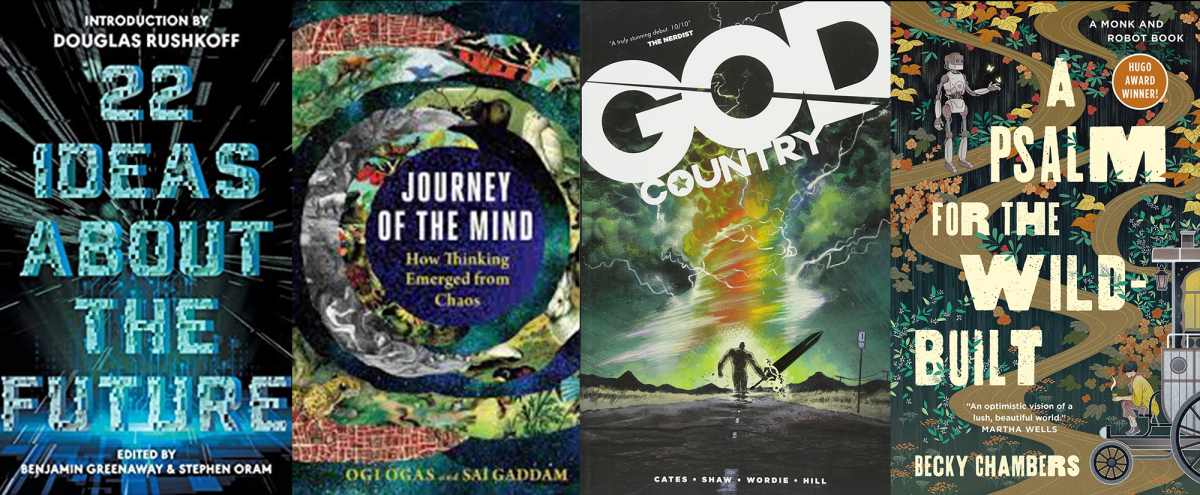
A collection of short sci-fi exploring the present through elabourations of technological trends, plus essays picking at the threads the authors have raised. The ideas are more interesting than the prose, which can come across a bit amateurish—but then these are meant to be bite-sized provocations more than complete stories, so it’s hard to complain on that front. The bulk of the stories are dystopian, extrapolating the worst tendencies of our modern systems into bleak Black Mirror vignettes, but I was pleasantly surprised to see a mix of hopeful stories in with the cautionary tales, along with some that are a mix of both. Tech is rarely just one or the other, and these brief glimpses into possible futures are a great way of illustrating that mixed potential.
An interesting book that doesn’t quite achieve what it promises (the humble task of resolving the age-old question of what consciousnes is and how it emerges from unconscious matter). The authors seem convinced that it does, and maybe something is lost in the translation from math-heavy research papers to accessible prose, but I don’t think I’m any closer to grasping it.
The key chapter on self makes a distinction between consciousness and self-awareness that I’m having a particularly hard time with, essentially saying that many creatures have qualia experiences of the world, but only humans are aware of themselves having them (unless they’re actively engaged in something like the mirror test, at which point a self-aware self emerges only to disappear once the mirror is removed). And I just can’t grok the concept of consciousness without awareness.
The idea of consciousness as a process, like a basketball game or hurricane, seems accurate but not exactly groundbreaking, and also an oversimplification. After all, a game is only a game because of the conscious actors playing it, and a hurricane is a dramatic example but that comparison relies on the drama of the image; a waterfall is a similarly context-dependent arrangement of water, but you’d be hard-pressed to convince me that saying “”consciousness is like a waterfall”” would tell me anything useful. Game, hurricane, and waterfall are all categories that emerge out of conscious beings assigning names and categories to physical processes; it’s hard to see how they can be used to explain the emergence of consciousness itself.
I did find it was wonderfully written, and its descriptions of mental processes were clear and informative. I don’t feel much closer to understanding the mystery of the self, but there’s plenty to chew on regardless (as evidinced by the fact this summary is double the length of the other three combined).
A neat pairing of Jack Kirby-style cosmic gods and rural family drama—a story about memory, loss, death, and chopping up space-demons with a sentient 12-foot sword. It’s pulp, but well-done pulp, with enough world-building to feel fleshed out but not so much that it’s bogged down in its own mythology.
Cates’ take on the cosmic realm is more coherent and grounded than Kirby, for better and worse—I’m a sucker for that Kirby krackle, and the incomprehensibility of his mythos was part of the charm. But God Country’s groundedness is a nice spin on the subject matter, and there’s no denying the book does everything it sets out to do.
If I were able to write fiction, I think this is the kind of fiction I’d like to write. The first book in the Monk & Robot series is gentle and thoughtful, but manages to pick at some anxieties I’ve been having for a long time, about purpose and direction and satisfaction. There’s not much in the way of conflict, but plenty in the way of insight, and it’s short enough that I basically inhaled it.
Even more than the characters, I want to spend more time with the book’s religious system, which is revealed in small details but still largely mysterious by the end of the book. The best fictional religions have a way of concisely showing what’s important in a given world—which I guess real religions do, too, but those are so much more multilayered and convoluted from centuries of revision and interpretation that it takes real scholarship to that heart. A religion in a fiction is more concentrated by necessity, but still abstracted enough to have that feeling of mystical importance, a distilled philosophy dressed in metaphor. I’m hoping Chambers delves into it more in the sequel.
BookWyrm says I’ve read about 6,500 pages this year (which probably includes a bunch of appendices and end notes that I didn’t actually read, but I’ll still take it). I feel like a very slow reader compared to some of my more literary friends, so making it through 20 books (including a couple of novellas and essay collections) feels like an accomplishment. Especially considering all of the other books I’ve started and set aside, or skimmed with the intention of returning to, or am still chipping away at when the mood hits, of which there are probably at least another dozen. I’m a very inconsistent reader, is what I’m getting at.
Which means the books I actually finish tend to be ones I’m genuinely enjoying—and that makes ranking into a pretty arbitrary task. So instead, just assume that if the description seems like something you’d be interested in, it’s probably worth the time investment. Keeping in mind my reading tastes can tend towards the dry and semi-academic.
I still need to do a better job of diversifying my reading. Of the 19 authors below, nine are women or people of colour, which means more than half are neither of those. Something to work on in the new year (and most of the books on my immediate to-read list will help with that, at least).
An unflinching graphic novel documenting Beaton’s time working in the oil sands—darker and heavier than I was expecting from Beaton, but the subject matter merits it.
For a writer who’s often put at the forefront of optimistic sci-fi, Robinson’s near-future look at how humanity might navigate climate change still feels mighty bleak. I guess we’re at the point where “making it through will be incredibly difficult but not completely impossible” counts as optimism.
One of two authors I had a chance to interview at Wordfest. Apocalyptic fiction from an Indigenous perspective, with the resilience and practicality that comes from having survived other cultural apocalypses already.
Adapted from King’s sermons, so more overtly Christian than most of what I read, but it seemed overdue to try to get a better sense of his actual thinking vs the sanitized hand-me-down version in popular culture.
One of the earliest “weird fiction” novellas. Still full of eerie atmosphere, but its ideas have been borrowed so many times that it’s tricky to see it with fresh eyes.
Another of those “reframing human history and experience” books, this time through the lens of the brain’s two hemispheres, in a much more nuanced manner than the usual pop-sci “left vs right brain” way. McGilchrist is impressively well-read in (Western) history, art, and philosophy, to an extent that the book suffers a bit from his thoroughness, but it’s argument is a profound one.
A poetic, dream-like detective story with an excellent sense of nature and place. Quick but cryptic, and nearly a year after reading it I remember the mood more than any of the particulars.
Liu has a skill for explaining interesting concepts, but so far I’ve found his storytelling a bit stiff, which made the cynicism of Three Body Problem harder to take. I’m glad to have read it, but not sure I’ll follow up with the sequels.
Some wonderful moments, and a fantastic title, but these short essays on a range of topics don’t quite have the impact of Rovelli’s more focused works—which are some of the most approachable and thoughtful explanations of quantum physics that I’ve ever read.
Another way of contextualizing human history, this time by looking at four key technologies—fire, language, beauty, and time. Optimistic and thought-provoking, and the only book I’ve read that encourages humanity to act more like a slime mold.
An attempt to find a more generous definition of “intelligence”, one that goes beyond “the thing that humans do” to encompass the perception and cognition of the natural (“more-than-human”) world. I think Bridle and I have been reading a lot of the same authors lately, as a lot of the anecdotes felt quite familiar. Still, I appreciated their interpretations, even if I didn’t always agree with them.
Thematic echoes with Bridle’s Ways of Being and McGilchrist’s Master and His Emissary, in that all three want to rebalance the analytical, fragmented, computational mentality of modern Western thought with other, more holistic ways of knowing. Lent provides a quick gloss of a lot of philosophies, not always convincingly, but it’d make for a good jumping-off point for a lot of further reading.
Applying Buddhist teaching to develop resilience and compassion. An excellent companion to Thich Nhat Hanh’s Being Peace, with slightly more focus on personal well-being. Not sugar-coating the nature of reality (the title is when, not if), but making acceptance a little easier.


 Wander Lines