March at the movies

Capsule reviews and stray thoughts from March 2024. All reviews via Letterboxd.

Ghostwatch (1992)

Even knowing some of the stories (the public inquiry, traumatized children, banned from the air for a decade) I still assumed this would be more spooky than scary. I mean, how far would the BBC really go with a fake live broadcast ghost story?

Turns out, pretty damn far. Ghostwatch is exceptionally well done, slowly ratcheting the tension for the first 70 minutes and then absolutely going for broke. The backstory that develops is so much darker than I would have expected, and the “found footage” aspect is clever and effective, seven years before Blair Witch, and with the added credibility of BBC presenters.

Seriously scarier than most theatrical horror movies. No wonder the British Journal of Medicine apparently cited it as the first TV show to cause PTSD in children.

Max Headroom: 20 Minutes into the Future (1985)

I was expecting more Max Headroom in this, to be honest.

So you have an advertising conspiracy creating concentrated ads that have the potential to explode people—but only the laziest slobs who are most susceptible to overstimulation. You have the intrepid reporter as hero, the pirate TV host who stumbles into a hit show, and the glitchy CG character (actually just some well-made prosthetics) who’s destined to be a sensation.

A lot of good elements, but the whole doesn’t really add up to much. Impressive that someone saw the potential for a mass-market phenomenon in the tiny clips of Max, because this scrappy made-for-TV cyber-punk thriller really is just seeds and not much more.

Love Lies Bleeding (2024)

Must be the season of the pulpy lesbian crime dramedy.

But despite the high-level, completely superficial similarities to Drive-Away Dolls, this is very much its own thing, a mix of magic realism, body horror, and off-kilter eroticism that’s hard to take your eyes off of (except in a couple of scenes that push the violence to limits where I had no trouble averting my eyes). I’ve heard complaints that the climax is too A24, but I haven’t hit my saturation point on their aesthetic and would gently push back on the idea that they even have a consistent enough one that it’s worth getting up in arms about.

Ed Harris would make a great Cryptkeeper.

Dune: Part Two (2024)

Maybe it’s the depression talking, but I didn’t really connect with this. Not to say I didn’t marvel at it—Villeneuve is undoubtedly a master of scale and Dune: Part Two looks, sounds, and feels absolutely monumental. But that scale is a cudgel; I didn’t feel moved so much as beaten into submission.

Some of it I loved. The early shot of soldiers hovering up a mountainside was gorgeous. Javier Bardem smuggling unexpected warmth and humour into such a self-serious setting. The brief detour to HR Giger’s Riefenstahl‘s Ancient Rome under a black hole sun. The craft that went into all of this is incredible, and I’m glad to have seen it all on Imax, like God intended.

Aside from the score and a completely miscast Christopher Walken, there wasn’t much I actively disliked. I think it’s more that the scale demands detachment; when everything in a film is this large, it becomes inhuman, and the characters never managed to fill in that space for me. Maybe that’s appropriate for a story about destiny and the grand sweep of history, but this still could have used a bit more life.

The Holdovers (2023)

Not exactly a “they don’t make ’em like this anymore” situation, but it’s a bit telling that when they do make ’em, so much effort is put into creating the illusion that it’s a 50-year-old film that’s somehow been rediscovered.

Everything about this is comforting to me. The cranky holiday mood, the well-worn character arcs, just the right vibe for someone who ocassionally wonders if he’s a misanthropist but is very much a softy when you get down to it. Giamatti’s character is definitely how I’ve always pictured my future self, so even if his redemption arc is a little cliched, it’s still satisfying. And it’s impressive that this is Sessa’s screen debut; holding your own against Giamatti at his best has to be a daunting first assignment.

Small nit to pick, but with so much care put into making this feel period appropriate, it does seem like an odd choice to include a couple post-millennial songs on the soundtrack, even if they didn’t feel particularly out of place. Didn’t detract, I’m just curious what the logic was.

(Also, I’m very curious how the real-world plagiarism accusations pan out.)

A Bucket of Blood (1959)

I’m an unashamed member of the Dick Miller Appreciation Society, so it’s great to see him hamming it up in one of his earliest roles. Not as grisly as the title led me to think, with a plot that actually hews fairly close to Little Shop of Horrors (another Corman flick), but worth watching in its own right for the loving shots at Beat culture. The film opens with a poet who is meant to be pompous and insufferable and in all honesty, I kind of dug it. Not enough to embark on a murderous art career, but it still spoke to me, for whatever that’s worth.

Ishtar (1987)

I’m glad the consensus on this has shifted in the last few years so I don’t have to wonder if I’m just being contrarian when I say this was a delight. Some of the loudest laughter I’ve had at a movie in a long while. Beatty and Hoffman are great as aspiring songwriters who are blissfully oblivious to how awful they are, and the film strikes a good balance of laughing at them and buying into the joy of collaborating on even terrible music. (Having them play againt type is also fun; Beatty is surprisingly good at turning his charisma off completely.)

I do understand the criticism that it loses steam when they leave New York, but even if the idiots abroad plot distracts from what makes the first 20 minutes and especially the last 5 so great, it also gives us a blind camel and Charles Grodin’s CIA man, and I wouldn’t want to give up either of those things.

It really goes to show how much the pop culture memory of a thing can be so disconnected from the reality. I can’t imagine that audience would’ve viscerally disliked this if they’d actually seen it, and not been pre-poisoned by the bad press. There are much worse movies out there with much better reputations.

Road House (2024)

For a good Buick, watch the original instead. 

Everything has to be a trauma plot now. Can’t just have the world’s most competent zen bouncer working his magic. It has to be a borderline suicidal guy navigating his guilt and anger management issues — when he isn’t being incongruously zen, too. Very inconsistent characterization. 

My college essay of this would be on how the remake reflects the erosion of America’s faith in expertise, but that’s a bit much for what seems like it’s mostly an excuse for ol’ Jake to show off his abs (and I can’t blame him…). At least he seems to be having fun. 

The fact they renamed the road house Road House speaks poorly for the modern world.

Immaculate (2024)

If I was ever going to watch this (a horror film that’s probably most easily summarized as Suspiria meets Rosemary’s Baby in a convent), Good Friday was probably the right day for it. Otherwise a very middle-of-the-road horror film that I will probably forget about entirely in a week or two. Beautiful setting, though, and some pretty effective sound design.

Someone brought a kid who was maybe 12 to the screening, which seemed like an odd choice.

February at the movies

Capsule reviews and stray thoughts from February 2024. All reviews via Letterboxd.

American Fiction (2023)

Felt like a bit of a bait and switch, but a thematically appropriate one, at least. The trailer had me imagining Boots Riley energy, or maybe an updated spin on Bamboozled, but a few sequences aside, that’s not what this is up to at all. This is a family dramedy with an occasional subplot about literary fraud, not an angry satire about the state of Black representation in pop culture. It does dig in on the satire every so often, and yeah some of those shots it takes are great (one involving an RBG poster definitely did me in), but that feels secondary to the real relationships that drive the film.

Which is part of what makes the ending feel like a cheat. More charitably, it makes sense for the satire I thought I was getting, but not for the human story that was actually the bulk of the movie. It leaves the whole thing feeling more muddled than I expected for a best picture nominee, but even that somehow seems like an extension of the point the film is making.

The Tragedy of Macbeth (2021)

Ever since this was first announced I’ve been curious why Joel Coen would choose this as his first solo project. Now that I’ve finally seen it, I’m still unsure. I see the connections to other Coen works, but as far as why this film at this time, I’m still at a bit of a loss.

Visually it’s magnificent, and feels like a love letter to European arthouse from Caligari and Joan of Arc to the Seventh Seal. It feels meticulous almost to the point of being overfussed, but when you get images like the reflection of the weird sisters in their introduction, it’s hard to complain. The performances are also universally strong, at least in their individual moments, but there’s some of the same rigidity in the way they come together that keeps it from conveying the tragedy of the title. Even knowing the shape of the plot, I didn’t feel the sweep of the narrative, which was surprising given the calibre of talent involved in every part of this.

Certainly worth watching, but as a curiousity more than a statement.

Black Mirror: Demon 79 (2023)

I fell off of Black Mirror years ago, so no surprise that the episode that’s most criticized for shedding basically all the show’s hallmarks is also the one I’ve enjoyed the most in a long while. Nice period textures, goofy plot, more interested in story than message (though the political subtext is far from subtle)—it’s a 75-minute demon-murder lark and if a stalled spinoff of Black Mirror is what it took to get it made, so be it.

Starman (1984)

Nice to see John Carpenter straying from the nihilism of so much of his work for something sweet and even a little silly. Bridges’ performance as an alien discovering how to use its new human body could have been irritating, but he settles into the right balance of quirky but contained. I love the way his attention is always in motion, the way he seems unfamiliar in his body, never quite using it properly. Something about the physicality struck me as bird-like, and I really wonder if that was intentional.

I can see why the studios worried this would seem too similar to ET, but 40 years on, they very much feel like different stories for different audiences. Watching it I found myself thinking of Contact more than anything Spielberg—maybe because I’ve seen it more recently, but the sense of hope, the love of science (and SETI), the loathing of militarism, and even the basic idea of the alien taking the form of a lost loved one, it’s hard to deny the echoes.

His Girl Friday (1940)

A rewatch because it’s been more than a few years and my partner has never seen it. It’s billed as a screwball romance, but I’m not sure whether it’s a love story or a hostage negotiation. Either way I laughed a lot.

This movie basically never takes a breath, except when a room full of journalists pauses to reflect on the glibness and cynicism of their worldview, laid bare by a desperate woman at the end of her rope. The fact the movie finds room for that, and then jumps right back into the snappiest, overlappingest dialogue this side of, well, anything, is impressive as heck.

Insert Coin (2020)

Fairly standard talking-head-style documentary about Midway Games, the company behind Mortal Kombat, NBA Jam, and other over-the-top arcade classics. Good for background viewing, but not if you’re looking for something with a perspective or a message beyond “remember these games?”

A guy in this thinks he’s being charming by saying he used probably illegal clauses in contracts and an army of lawyers to coerce staff into turning down better offer from competitors. So many people think they’re clever when they’re actually just cruel.

Amelie (2001)

(Post-Valentines Day screening at the Globe Cinema)

23 years ago I watched this at a beautiful local art house that has since been demolished and turned into a seemingly permanent development project that was recently used as a post-apocalyptic ruin in a major television series. As far as cinematic experiences in Calgary go, that was a foundational one for me—it was a joyful shared experience and a high that I’ve had a hard time matching over the years. It was such a perfect film for me at that time, its breathless pace, the whimsy and inventiveness, and just the allure of something foreign and different was catnip to my inexperienced self.

I knew I wouldn’t have the same reaction watching it now, even if it was in the local art house across the street from the shell of where I first watched it. But I was pleasantly surprised by how much of that joy it still holds. There are a lot more choices in it that I would second guess, and it doesn’t feel so entirely sui generis, but it’s still lovely, funny, generous, and warm, with a fantastic score and a relentless pace.

I do miss that initial viewing, though, and I really hope this city still has places that can give young movie fans an equivalent experience.

Drive-Away Dolls (2024)

Just the kind of pulpy, dark, throwaway fun I was looking for. It reminds me of the sort of post-Pulp Fiction gangster comedies that were ubiquitous in the late ’90s, which I guess now count as comforting, nostalgic viewing for me. I don’t think this means I have to rewatch The Way of the Gun and Go now, but I suppose I should consider it.

It doesn’t quite have the Coen rhythm to it, but it feels like Ethan had a lot of fun putting this together, which is good enough for me. I hadn’t intentionally tried to watch this and Macbeth in the same month, and I don’t want to overstate how much each film says about directors who have made such a wide range of movies, but it’s interesting for Joel to swing so heavy for prestige and Ethan for pulp. If that’s reflective of their usual dynamic, it’s easy to understand why they’d want to splut up for a bit, but they’re definitely better together.

I hope Curlie is ok.

Uzumaki (2000)

Another one I haven’t revisited in probably 22 years. My first viewing was very much in my “weird for weird’s sake” phase of movie-watching (which is essential, but also probably a bit insufferable), so I was worried this wouldn’t hold up at all. Especially given all the middling reviews on Letterboxd and my own increased awareness of the source material.

Seeing it with relatively fresh eyes, I’ll admit it’s not a masterpiece by any stretch, but it does have an atmosphere to it, along with imagery strong enough to stick with me for two decades. Most of the credit for that goes to Junji Ito, I’m sure, and memorable as it is, the imagery doesn’t hold a candle to his original artwork (surreal horror will always work better in more abstracted media). But viewed on its own, this is still a solid slice of weird cinematic horror—not scary, not even really creepy, but still capable of getting under the skin.

Side note: I watched a somewhat low-res version in YouTube, and I have to say, the digital decay sort of suits it? The way large chunks of the screen pop in and out of clarity based on the whims of the algorithm, it has this ever-shifting lack of reality that just works. That notion that a medium’s flaws are what you end up nostalgic for, strikes yet again.

January at the movies

Capsule reviews and stray thoughts on what I watched in January (and a bit of December). All reviews via Letterboxd.

Poor Things (2023)

On the one hand it’s certainly fun watching a self-proclaimed hedonist destroyed by a woman who genuinely doesn’t care about the rules of polite society, and the way supposedly intelligent men fall in love with a mental six-year-old is obviously meant to be stinging. But I can’t shake the feeling that this is a very masculine take on female liberation, especially in its fascination with sexuality to the exclusion of almost everything else. Bella is a cipher for most of the film, more defined by her effect on others than by her own inner life. Her alternative to the possessiveness of men is pure callousness verging on intentional cruelty. She’s a spin on the magic pixie dream girl, but less a subversion than a caricature. 

Except when she isn’t, and maybe that’s part of showing someone essentially inventing themself, and pushing against social limits in the process. You can’t be fully developed and a work in process at the same time. So sometimes she’s a male fantasy or a nightmare, others she’s a real person trying to understand her past and define her future. 

Anyway, it’s impressive to see what a stylist Lanthimos has become here. The performances are mostly sharp, and the production design and costuming deserve all the awards they’re bound to get. This is vivid, imaginative, and fun, but it does leave me feeling conflicted.

The Creator (2023)

Hero’s journey, blow up the Death Star with the Force space fantasy with a bit of hand-wavey political subtext for good measure. I’m glad that a non-franchise story can get told on this scale, but if I’d realize I was getting into a 2.25-hour set of military skirmishes with shades of Eastern mysticism thrown in as set-dressing, I would’ve just accepted it as “not my thing” and moved along. There’s not nearly enough time spent establishing the relationship that’s meant to anchor the story, so it relies on indistinguishable action sequences and mawkish sentimentality for interest and gravitas respectively, and I found neither to be all that effective. I know others who enjoyed it, but aside from the visuals I found it quite dull.

Are You There God? It’s Me, Margaret (2023)

Our choice for first movie of 2024 was between this and a cult post-apocalyptic Aussie action film, and this was definitely the better choice. Sharp, fun, and genuine. Even with the title I didn’t realize how much religion would play into this, but even that is handled deftly. Good stuff.

Dream Scenario (2023)

I saw another review on Letterboxd that said this movie takes a fantastic premise and then takes the least interesting route at every opportunity. That’s overly harsh, but it’s not totally unfair, either. At a certain point, the movie drifts from being about a character responding to an absurd situation, to being about cancel culture and fame and the strokes just keep getting more and more broad. It gives way to a pretty rote downward spiral, which is disappointing given the odd but engaging specificity of the early scenes.

That said, I will always enjoy watching Tim Meadows doing his thing. I don’t know what it is exactly, but he’s just such a steady presence. He’s never let me down.

Paris, Texas (1984)

Mild spoilers

Travis starts the film as someone who doesn’t want to be saved, and ends it as someone who probably doesn’t deserve to be—he aims for understanding instead of atonement, and while he seems to recognize that he’s still a destructive force (hence the desire to disappear again), he doesn’t see that even his better intentions are still selfish and poorly thought through.

It’s tough, because Stanton is so likeable, and what Travis has done is so horrific. I want him to do better, or to be punished but it’s neither: he emerges from purgatory and then goes back to it, stuck in a stasis with nothing resolved. He runs from himself, puts himself in a place with no language and no memory, and leaves everyone else with the challenge of functioning and rebuilding and carrying on.

The Quick and the Dead (1995)

The ’90s were pretty great for getting a bunch of fantastic character actors, a weirdo director, picking an underappreciated genre, and just going for it. I don’t know for sure that this got greenlit after Pulp Fiction became a smash, but it really feels like it’s of that era where no one quite knew what was going to work, so they took a bunch of swings just to see what would happen.

Gene Hackman is great as always, a pre-Titanic DiCaprio is somehow already mocking his pretty-boy image a year before Romeo + Juliet even came out, and even dang-ol’ Woody Strode makes a cameo. Raimi takes the close-up-on-the-eyes thing to ridiculous extremes. Lance Henriksen gets to play the least Lance Henriksen role I’ve ever seen and he eats it up. Russell Crowe is even almost likeable.

This is just fun, is what I’m saying.

The Rat Catcher (2023)

First of Wes Anderson’s Roald Dahl shorts that I’ve seen (we don’t have a Netflix subscription right now), and the tone is certainly something. Somewhere between storytime, children’s theatre, and student film, albeit with incredibly talented people handling all the details.

I almost would’ve preferred if the short hadn’t used a prop/animated rat at all—they were so committed to the bit of imaginary props that it was a bit of a letdown to drop it. Otherwise, I’m not really sure what to make of this. It’s a fun diversion, and it seems like that’s probably all they were going for, so… well done, I suppose.

Ruthless People (1986)

Would never have guessed that this is ZAZ (directorial trio Zucker Abrams Zucker)—the sense of humour is completely different from your Airplanes and Police Squads and Hot Shots, much more grimy and mean and, well, Danny Devito-y, for lack of a better term. And I think it would’ve been better with someone like Devito at the helm really playing up those elements, because as it is, it’s directed a little more lighthearted than the plot and subject matter really call for. In other words, it’s not vicious enough for how vicious it is, if that makes sense.

But Bill Pullman is phenomenal in this, and they gave Sally Cruikshank some work on the opening credits, so I’m still all for it.

Elemental (2023)

Something felt off in the scale of this. There’s such elaborate world building in its depiction of a massive city populated by elemental creatures; you just know someone has a 100-page bible outlining each Element’s architecture and cultural history and technological preferences. The story itself is relatively intimate and personal, but because the world is so elaborate, it feels like it’s is going to go bigger—there are recurring floods in the city that seem poised to open to some Chinatown-style conspiracy, or at least something that ties more deeply into the narrative—but it never does. It’s just there because the filmmakers needed a big set piece, even though the stakes of the smaller story would have been more than enough. 

Magic (1978)

It would be fun to sell people on this Anthony Hopkins muderous puppet movie by saying “it’s from the author of the Princess Bride” just to see what happens.

The main character, a musician/ventriloquist named Corky, is more a Michael Moriarty character than a Hopkins one—my memory is already sort of swapping in Moriarty’s jazz musician from Q: The Winged Serpent into the role—but Hopkins really does give this his all. Ann Margret has to sell the idea that anyone would find this act charming enough to throw away your life, and does a decent job showing the desperation that would require. It stretches credulity more than a few times, but it’s effective all around. 

I fully believe that Burgess Meredith’s aging agent would pitch a combination ventriloquist/magician act as the next big thing; less confident audiences would eat it up, but hey, I wasn’t alive in 1978 so what do I know. They reference Steve Martin and Rich Little and maybe they saw that as proof of a neo-vaudeville revival. So, sure.

October/Schlocktober Letterboxd Roundup

I can’t deny this was a bit of an indulgent Schlocktober — not a lot of highbrow viewing, but definitely an enjoyable amount of campy horror. This doesn’t include Guillermo Del Toro’s Cabinet of Curiosities anthology, mostly because I feel like I have more to say about what that series shows about the state of modern horror, but I’ll need to stew on that for a bit.

John Carpenter’s Prince of Darkness

I’m a huge fan of the other two films in Carpenter’s Apocalypse trilogy, but this one doesn’t really live up to the other two. The ideas are there, but the execution isn’t. The pacing feels off—there’s no ebb and flow to it, just a steady pulse established by the opening credits. Which could be interesting, as a way to create a feeling of relentlessness and inevitability, but it just feels choppy. There are no real conversations, no real moments, just fragments after fragment.

You can definitely see how it’s meant to be a culmination of themes and styles that Carpenter has explored, how the tension of Assault on Precinct 13 and the inner threat of The Thing and the Donald Pleasance grappling with physical manifestations of evil in Halloween are meant to fuse into something more profound. And I’m here for any film that’s grappling with the fundamental nature of reality—that heady blend of pop science and Christian mysticism and occultism and high strangeness is a place I’d love more movies to end up. But this one feels like it aimed higher than it can achieve—not the worst crime, but it lands with a bit of a thud.

Most effective moments:
The dream broadcasts
Insect-voiced “pray for death”
And Calder’s laughter was 100x more eerie than any special effect


The Blob (1988)

The practical effects in this are incredible; the optical effects a little less so but still pretty effective. The pacing is relentless, exactly what you want out of a popcorn flick, and even the half baked conspiracy plot can’t slow it down.

I know we’re supposed to be down on remakes, but between this, the Fly and the Thing, the ‘80s really showed how to do ’em right—apparently the key is rubber tentacles and biological acid.

The only thing it’s missing is the Bacharach theme.


Lair of the White Worm

Delightfully ridiculous. Amanda Donohoe commits far beyond what the movie deserves, and it pays off every time. Hugh Grant less so—he seems a little embarrassed to be involved—but Peter Capaldi playing bagpipes and pulling a hand grenade out of his kilt more than makes up for it.

Is any of the ridiculous Freudian “sub”text remotely successful? Not really. But I think the movie knows that—it seems pretty likely that Russell is poking fun at the clunkiness of the novel. Is it campy and fun and great late-night viewing? Absolutely.


Terror Train (1980)

An ok but fairly unmemorable slasher, distinguished by a more than reasonable amount of time spent speculating about the role of trains in America’s future intermodal freight systems, and an entirely reasonable amount of David Copperfield doing his thing.

The remake better still use Crime as the house band.


Popcorn

One of those VHS cases that was burned into my mind as a 10-year-old browsing the horror racks at my local video store, but I never got around to seeing it. The films-within-the-film are great in their low-budget campiness, but that same goofiness becomes more grating when it bleeds into the “real” world of the film, especially given the more sinister tone before the big reveal.

I would still 100% go to the gimick-horror marathon in that gorgeous old theatre. The film introduces it like it’s run-down and awful, then take the dust covers off and it’s basically immaculate.


Tales from the Darkside

The gargoyle segment was the only one I remembered from watching it way back when, and it’s also arguably the weakest segment (with the best payoff, those transformation effects are incredible). That’s not much of a criticism though, as this is impressively consistent for a horror anthology. Even the wraparound story is solidly entertaining. Goofy, fun spooky-season viewing.


Tales from the Crypt: Demon Knight

Casting Dick Miller in anything is already a win, so Demon Knight didn’t need to do much to win me over. Billy Zane is clearly having a blast bouncing off a stacked cast. ’90s HBO does have a feel to it, doesn’t it.


Wendell & Wild

I’m not totally clear who this is aimed at? It has the general feel of a kids movie, but also on-screen murder, a plot that revolves around the for-profit prison industry, and a surprising amount of ska. Plus tardigrades, naive demons, origami theme parks, and proof of the cultural and economic importance of microbreweries. There are a lot of things happening with this movie, is what I’m saying, and as a geriatric millennial third-wave-ska-surviving stop-motion fan, by and large I enjoyed it.

Calgary International Film Festival 2022 round-up

Eight films in 10 days isn’t much of a marathon, but it’s more in-cinema movie-watching than I’ve done in probably the last year combined. Via Letterboxd, here are some quick, capsule-style reviews of seven of them. The eighth was a screening of Murnau’s Nosferatu with a live score by Calgary’s Chad VanGaalen — a great experience but not one I was compelled to write about.

Presented in the order I saw them:

Broker

A very enjoyable watch, warm, funny, and maintaining Kore-ada’s knack for staying just on the right side of sentimentality. Writing this a week after watching it, though, not much of it has stuck with me. One thing that has is the shot of the police officer idly playing with a flower that’s stuck to her car window — such a lovely, spontaneous image.

Geographies of Solitude

In a way, it felt like there were three or four different films here, all of them interrelated and complementary. There’s the immersive nature documentary, shot with an eye for the transcendent; a character study revealed through action rather than interview; an experimental mixed media film, with cameraless animation and found sound compositions; and an environmental documentary illustrating our cultural wastefulness.

That last part was my least favourite, but it’s understandable and probably unavoidable that it would be included. The other three were all superb, though, and they combine into something much more experiential than your average doc.

A few stray thoughts:
• I love how much the film focuses on Lucas’ hands so much more often than her face. She seems to be a person defined by *doing* so it felt appropriate
• I’m glad they included the Cousteau footage with its sweeping helicopter shots of the island, but mostly because it highlights how different that approach to nature docs is from what Mills is doing here. Seeing things from a human vantage, with slow, deliberate movement and lingering on small details; it’s more about capturing the feeling of being there
• There’s an odd contrast between Lucas’ meticulous dissection and indexing of everything that happens on Sable Island, and her openness to Mills’ artistic impulses. Impressive that she seems comfortable in both of those worlds, but it really seems she’s held onto a sense of wonder
• The sound design is brilliant
• I appreciated how Mills and Lucas both found beauty in the whole of life, from birth to death. The film captured that well, even without the monologue at the end

Viking

If I’d seen Rehearsal I might call this the low-budget Franco-Canadian sci-fi version, but in all honesty I have no idea how accurate that is.

The tricky thing about a movie like this is that it needs to take its premise seriously to have any emotional depth, but the more seriously it takes it, the more obviously ridiculous the premise becomes. I won’t criticize a comedy for proposing an unrealistic means for managing group psychology on a mission to Mars, but the more the film wants to plumb drama from its setup, the harder it gets to ignore those issues.

Still, it’s a charmingly dry comedy with real nuance to its characterizations, sort of the definition of enjoyable mid-tier Canadian film fest fare. And Nana Mouskouri’s cover of “Feeling Groovy” on the end credits is delightful.

Decision to Leave

This might be the stifling heat in the theatre talking, but the final act felt unnecessary, or at least underdeveloped compared to the rest of the film. I appreciate the transition from surprisingly funny procedural to outright melodrama — an enticing mix of Hitchcock and Sirk — but after the methodical pacing of the rest of the film, the last act feels rushed, introducing a torrent of new elements that muddy an otherwise engaging story.

Smoking Causes Coughing

Of the three Dupieux movies I’ve seen (this plus Wrong and Rubber), this is easily the most consistently fun, even if it’s also the most straightforward. I wasn’t expecting it to essentially be an anthology film, but that structure suits Dupieux’s sensibility—and takes the pressure off any one story to stay engaging for more than a few minutes at a time.
It’s not very ambitious, but the brisk mix of gross-out gags, non-sequiturs and gentle nihilism (with a soundtrack dominated by Mort Garson’s chintzy synth daydreams) makes for pretty ideal late-night fare.

Something in the Dirt

A semi-satirical spin on paranormal investigation/conspiracy culture acts as a backdrop for an exploration of collaborative creation and the hollow desperation of Hollywood dreams. A difficult film to talk about, both in that it’s hard not to give things away, but also that it’s hard to be certain how to read any given scene, what with the metastructure introducing layers of unreliability into every part of the storytelling. But the half-baked research and pseudoscientific mumbo-jumbo were (I think intentionally) laugh-out-loud funny at times, and the aura of unease makes it hard to look away.
Not what I was expecting it to be, that’s for sure, but it’s lingering with me.

Triangle of Sadness

In the first act, one of the main characters complains about how difficult it is to talk openly about money with people you care about. It’s such a loaded topic, with so much baggage around social status, gender norms, self-esteem, and on and on. That could’ve been a mission statement, but the film takes the easy way out instead—it gestures at ideas around money and class, but avoids any open, honest conversation.
Instead, it picks the easiest targets it can find, and does absolutely nothing to challenge your initial assumptions about any of the characters (or the segments of society they are meant to represent). Rich people are dumb, thoughtless, and useless. Working class people can catch fish with their bare hands and start a fire from scratch. Everyone is exactly what you expect, nothing more or less.
If I hadn’t gone into this with the baggage of knowing it was a Palm D’or winner, I might’ve enjoyed it more for what it is—a prestige gross-out comedy with some broad social commentary to add a patina of intellectualism to the poop and puke jokes. It’s beautifully made, and the theatre I saw it in reacted exactly the way the director intended, so it’s clearly effective in that regard. It just doesn’t have much to say. The characters may quote Marx and Chomsky, but the film’s critique doesn’t go much beyond “rich people are bad” and “power corrupts.”

Summer film roundup

Collecting some Letterboxd reviews from the past few months, some more obscure, some very much not so. I haven’t been watching as many films the past few months, but between the start of the Calgary International Film Festival and the looming winter, that’s bound to change—expect more of these roundups in the months to come.

The Northman

This is a strange thing to say about a bleak Viking revenge saga packed with bloodshed and laced with hallucinatory visions, but as much as I enjoyed the experience of The Northman, it’s missing the darkness of The VVitch and The Lighthouse. Maybe it’s in the relationship of their central characters to their worlds—Eggers’ first two films are about average people on the fringes of their societies, butting up against and succumbing to forces beyond their understanding. This is a hero’s journey, the toughest man alive receiving DMs from the fates themselves assuring him of his central role in a high drama of kings and conquerors. In some ways, it feels closer in tone to old Conan comics than to either of Eggers’ other films.

As an action spectacle, it’s impressive and enjoyable, and I’m glad the larger scale hasn’t diminished Eggers’ commitment to his historical worlds. I saw another review say what distinguishes his films is that they 100% believe in the mythology of their times, so you are seeing the world from within their reality—their histories are alien worlds, to some extent, and that really does seem to be the case. And I appreciate the seriousness of it, the acknowledgement that you can go big without having to bake in quippiness and meta-jokes. It’s a great action movie, one that holds on to a lot of what makes Eggers so unique—but not enough pair with his best.

The Velvet Underground

I adore the energy Jonathan Richman brings to his segments.

Haynes certainly does what he sets out to do, elevating his favourite band while also bringing them down to earth by spending so much time establishing their context. The pre-Velvets parts were maybe my favourite, the rest being a well-worn story and way too heavy on Warhol, who may be what made the Velvets’ career possible but isn’t what made them interesting.

What a band, though.

The Matrix Resurrections

In the first movie, “what is the Matrix” was a question about the nature of reality. In Resurrections, it kicks off a branding discussion. I don’t know that I’ve ever seen a movie that so explicitly didn’t want to be made, that isn’t just aware that it is superfluous but that seems to want you to feel guilty for even being curious about it. Neo and Trinity are back because either Warner Media or the engagement algorithm that secretly drives the world have demanded it, and while the postscript grudgingly thanks the algorithm for the characters’ new life—and the opportunity to clarify a few ideas and shake up a few binaries—it never gets past the sense that this revisiting this story is more traumatic than cathartic for its creators.

Nope

Not trying to open up the genre debate because ultimately it’s just a label that doesn’t mean much, but this didn’t feel like a horror film to me. In that I didn’t feel the goal of the film was to scare me; it has more the feel of a pulp “men’s adventures” magazine, a tale designed to thrill more than to frighten. If Peele hadn’t already directed two horror films, I wonder if this would still be discussed in those terms.

Anyway, Nope doesn’t hold together as well as Get Out (that’s a high bar). It balances its theme and storytelling much better than Us, though, and the creature design is marvelous. Kaluuya is great in a mostly low-key and stoic role, “Antlers Holst” is a fantastic name, and all my criticisms are better suited to nitpicking over beers than essays on Letterboxd.

Inu-oh

Who even makes movies like this? Yuasa is one of the most unpredictable filmmakers working today, except inasmuch as everything he makes is worth watching. Which very much includes this 14th century Japanese mystical rock opera. Yes it’s a bit chaotic and inconsistent from the storytelling side of things, with uneven pacing and what feel like some fairly significant dropped threads.

But it more than makes up for it by force of imagination. The production value on the musical numbers is incredible, the animation is gorgeous throughout (even with a few jarring shifts in technique), and most importantly, it never once plays it safe.

How do you do this, The Night is Short Walk On Girl, Lu Over the Wall, Devilman Crybaby and more in a five-year span? It boggles the mind.

Three Thousand Years of Longing

So much of this film is so good. I’m a sucker for movies about storytelling and well-used narration and colourful world-building and genre-based tragic love stories, and apparently Miller is, too, because when he’s indulging in that side of things this film is so wonderfully alive.

The scale of those early stories is so ambitious that the more restrained back half can’t help but suffer in comparison—but it doesn’t help that it feels so rushed. Why raise a topic like bigotry and xenophobia, say, if you’re only going to give it one brief conversation and a cartoonishly simple resolution? There wasn’t enough room for the sweep of humanity that the script tries to engage with.

None of that changes the appeal of the first half, though. It reminds me a bit of The Brothers Bloom, although the content couldn’t be much more different, but that love for the very nature of storytelling, the embrace of bright colours, the playfulness and love of language will appeal to the same people.

Worth noting: it’s a very different film than the trailer had me expecting. Less chaotic, more constrained, very much not an adventure film. Hopefully that doesn’t hurt its reception.

Dozens of Norths

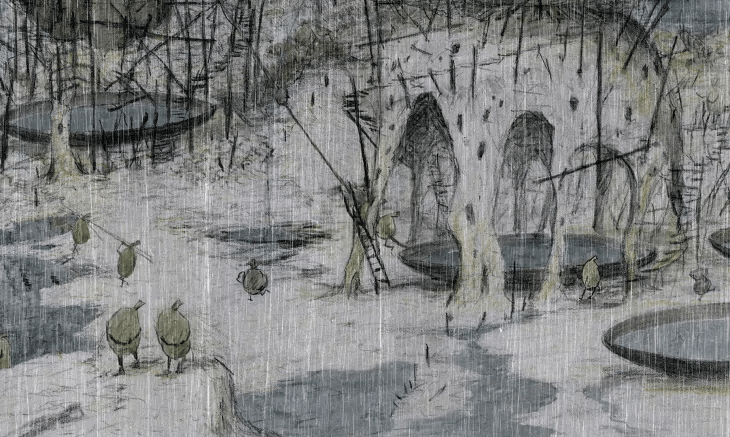
Somewhere between Seuss and Bosch—a journey through imagined landscapes full of people trapped in loops, stuck in traps, or engaged in endless work. Absurdist allegory that seems borderline nihilistic, although I’d be lying if I said I had a solid interpretation of it overall. Some of the metaphors were clear, but others sailed by me; the rough-hewn illustrations and the fantastic score and sound design were enough to pull me back in whenever I started to drift. The lack of dialogue in favour of title cards helps contextualize some of the more obtuse imagery while still keeping things wide open to poetic interpretation.

Certainly an imaginative film—if it’s even fair to call it a film, it doesn’t seem especially interested in cinematic language, pulling more from illustration and mixed media to create its mood. Animation doesn’t have to be filmmaking, after all, it is its own medium with the flexibility to pull from so many other visual traditions. But I guess that’s a whole other can of worms.

The Empty Man

An ambitious jumble of ideas and influences, some well thought out and others pretty half-baked, but executed with a whole lot of skill regardless. The (very) cold open and the scenes with Root are by far the most engaging; the procedural is a bit rote even with all the weirdness around it. Some of the images, though, especially the sequence at Elsewhere, flames tentacling into the night sky… I can see how this has attracted a cult.

Folks seem to be calling out the creepypasta elements like they’re inherently a bad thing, but I’d happily read the whole Pontifex Society wiki if it were posted somewhere. Candyman + Crowley + Creepypasta + Cults makes for an interesting blend.

The Timekeepers of Eternity

Certainly an interesting project. It’s a snappy edit, finding a solid Outer Limits episode in a much-reviled miniseries, and the unusual technique heightens the film’s themes, adding some interesting depth. Where I stumble is in whether it is its own film or something closer to a fan edit, or whether that matters.

If you go by sheer labour, then it isn’t hard to argue for it as a standalone artwork. If you go by originality of the narrative, it’s an edit. Is it transformative? Does it matter? The fact it prompts those questions is enough to make me glad I watched it.

Regardless, it’s easily the best film version of the Langoliers out there right now, so there’s that.

Nate Milton + This American Life tackle fossil fuels

Drawing of a hand holding a lump of coal between its thumb and index finger in front of a clear sky and glowing sun

Animator Nate Milton’s Eli was a highlight of 2019, a personal and highly ambitious dive into the worlds of manic delusion, magical thinking and high strangeness. Although he’s released a few odds and ends since then, he held off until yesterday to share another ambitious project: a trio of short films on fossil fuels and climate change, created in collaboration with This American Life and broadcaster Robert Krulwich.

Krulwich’s folksy narration and Milton’s loose, hand-drawn animation complement each other marvellously, each of them alternating between gravitas and whimsy, though not always at the same time. The science Krulwich shares here is nothing groundbreaking, but it’s presented clearly and creatively, outlining the scale of human consumption and not mincing words about the potential consequences. Milton’s love of science and reverence for the natural world come through in spades, his knack for distilling complex emotions into singular images serving him well in the world of science communication.

The trilogy premiered on CBS Sunday Morning in June, and all three together take less than 20 minutes to watch. Not a bad way to add some educational content to your media diet.

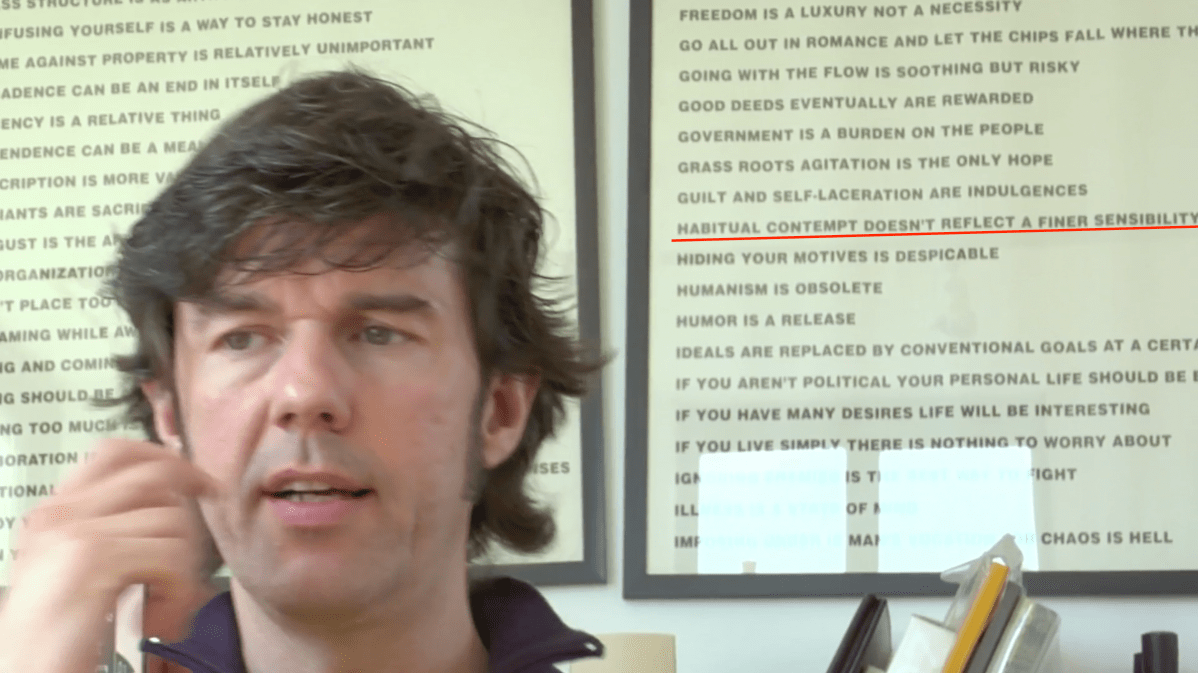
Habitual Contempt and Helvetica

Habitual contempt doesn’t reflect a finer sensibility

It’s been 15 years since design doc Helvetica came out, which means it has been 15 years since I noticed this quote in the background of their interview with designer Stefan Sagmeister. In that decade-and-a-half, my memory contorted the quote just enough to make the source impossible to find—I’d turned it into “habitual cynicism does not reflect a refined sensibility,” which I guess was closer to the insight I’d needed at the time. Snarkiness and cynicism were very much still in vogue I when I was trying to find my voice as a pop culture writer in the mid-2000s, and my jumbled version of the quote played a major role in my realization that advocating for the things I enjoy is a more valuable contribution than explaining why popular things are actually awful.

To celebrate the documentary’s anniversary, film and visual art collective is streaming Helvetica for free worldwide for the next week, which was as good an opportunity as any to track down the actual quote. Turns out it’s part of conceptual artist Jenny Holzer’s Truisms, 1978-1983, which to my modern eye is a real mixed bag of statements, from Tao-inspired wisdom (“at times inactivity is preferable to mindless functioning”, “the most profound things are inexpressible”) to misguided self-indulgence (“exceptional people deserve special concessions,” “giving free reign to your emotions is an honest way to live”). Even if I disagree with about half of it, though, it strikes me as a list worth spending some time with. Given how much a misremembered version of one line has impacted me, it’s bound to have some other useful prompts.

Sound of Ceres – Arm of Golden Flame

Sound of Ceres, the cinematic dream-pop evolution of shoegazers Candy Claws, has announced an ambitious new album “inspired by Maurice Ravel’s ballet Daphnis et Chloé, Gustav Holst’s The Planets, and Les Baxter’s midcentury exotica.” The album follows a three-act narrative structure to explore the emergence of mind and meaning in an otherwise meaningless universe, which is quite a lot to tackle, but with narration by performance artist Marina Abramovic (who is set to restage her iconic piece The Artist is Present as a fundraiser for Ukraine) and dramatic orchestral accompaniment, the first single “Arm of Golden Flame” certainly sets the right tone. This will be one to watch out for.

Due out June 17, 2022 on Joyful Noise.