Recent Reading: Q1 2024

(also including a bit of April)

The Handover

David Runciman

tags: non-fiction, AI, politics, capitalism

Having listened to many hours of Runciman’s podcasts, it’s always a treat seeing how well his voice translates into his writing—approachable, inquisitive, and authoritative in equal parts. The conception of states and corporations as artificial agents is an interesting thread he’s been pursuing since at least How Democracy Ends, and is a helpful framing for thinking about how much agency we’ve already handed off to non-human entities, even before bringing AI into the mix. It’s always good to remember that there’s a big difference between “novel” and “unprecedented,” and there’s almost always a historical context worth learning from.

The Wendigo

Algernon Blackwood

tags: novella, weird fiction, weird nature, feet of fire

Not as atmospheric or as haunting as The Willows (a story where not much happens, but it happens vividly), but memorable in its own right, especially if you can set aside the of-its-time racism that crops up a couple of times in the opening chapter. Mostly, it’s Défago’s oddly poetic cries that will stick with me, the rest of the story being fairly boilerplate weird fiction—or at least what would become boilerplate in the decades to come. Still, one phrase sticking with me is really all I ask for from something this short.

Mind MGMT Vol 1 – 6

Matt Kindt

tags: graphic novel, conspiracy culture, psychic warfare, immortals, dolphins

I very much appreciated the density of this series and the effort of the watercoloured artwork, although I worry a bit when density and effort are the first things I think to compliment. Kindt presents an absurdly intricate world with its own intuitive (or at least intuitable) logic, and while it sometimes can seem too multilayered for its own good, it generally manages to keep the story as the central focus.
Never quite attains the mystic highs of something like Grant Morrison’s Invisibles—despite its focus on altering minds, I wouldn’t quite call this psychedelic—but there’s a unique world, unique art, interesting use of the medium, and a story that doesn’t strain to fill a half-dozen trades. It more than justifies a read, in other words.

A Guest in the House

Emily Carroll

tags: graphic novel, haunted, phantasmagoria, trauma

Fantastic. Atmospheric and unpredictable, beautifully blending the mundane and the phantasmagorical. Carroll’s artwork is exquisite, overtly on the pages where fantasy takes over, and more subtly in the dollops of colour that leak into the real world, especially when thinking of those in light of the ending. I love how unconstrained she is by panels or rigid structures; the story art seems so much more organic when it’s allowed however much room it needs.

Not a traditional haunted house story and that’s absolutely for the best. I never settled into a sense of knowing just what kind of story this was, and on the rare moments I did, whatever expectations I did have were nicely subverted. It’s unusual for an ending to reframe so much of what came before, with nothing contrived or forced about it. That’ll sit with me, for sure.

When reading something like this, I’m often struck by the difference in how much time it takes to create a page vs how long it takes to read it. Probably a good reason to revisit this sooner than later, just to see what details I didn’t pick up on the first time

Through the Woods

Emily Carroll

tags: graphic fiction, short stories, fairy tales, weird fiction

I definitely see the appeal of this one—Victorian/Edwardian* ghost stories with a more contemporary, weird edge—and if I hadn’t started with A Guest in the House I probably would be giving this more praise. But Carroll’s newer work is just so much more sophisticated, in its artwork and in its narrative, that I couldn’t help being a little disappointed with this. More a testament to her growth as an artist than a criticism of this one, which is still worth a read, just not one I’d likely go out of my way to recommend.

*I shouldn’t guess at eras, it’s really not something I know much about. Let’s just call it an era with both untamed wilderness and frilly garments.

Fluke: Chance, Chaos, and Why Everything We Do Matters

Brian Klass

tags: non-fiction, coincidence, interconnection, fate, free will

One of the risks of reading a pop-sci take on a subject you’ve spent a lot of time reading and thinking in is it can feel like a bit of a rehash or a gloss, and that’s how I felt for a lot of Fluke. It’s not a criticism of the book, which is thoughtful and features well-chosen examples for its look at the highly contingent nature of reality. Anything that tries to pull together threads of chaos theory, the interconnection of all things, and the impossibility of free will is admirable. I think this’d likely be a great primer for people new to these subjects and might open doorways into areas like Zen Buddhism, optimistic nihilism, and contemporary philosophy. It just wasn’t the right book at the right time for me.

The Weather Detective

Peter Wohlleben

tags: non-fiction, gardening, weather, flora, fauna

I’m not sure if this is on me or the book’s marketing, but I really didn’t expect this to be so much about gardening. The Hidden Life of Trees was wonderful and felt like it was exposing me to a whole world that had previously been invisible to me. This had some interesting tidbits, but felt closer to an advise column than a revelation. Still very approachable and knowledgable, but not something I likely would have sought out if I’d known what it was.

The Middle Passage

James Hollis

tags: non-fiction, mid-life, Jung, purpose, rebirth

I really need to put together some more thorough notes on this one, but in short, a lot of this resonated with what I’ve been feeling as I fumble into my 40s. A helpful framework for thinking about how to push through and emerge, if not stronger, at least more fully myself. The handful of exercises it offers are more about asking the right questions rather than providing concrete actions to take, but part of the whole point is that there are no easy answers, and I can see how looking for an outside authority to show you your true inner self would be counterproductive.

The Resurrectionist : The Lost Work of Dr. Spencer Black

E.B. Hudspeth

tags: fiction, fake biography, illustrated, novella

An odd work—essentially a short story disguised as a biography, paired with anatomical drawings of mythical creatures, which take on a darker tone when paired with the story. It’s a unique book, and the closing image of the story is ominous and ambiguous. There isn’t much in the way of narrative, and what there is, at least the more horrific aspect, is mostly implied. But it gives just enough to make sure it lingers.
Summer film roundup

Collecting some Letterboxd reviews from the past few months, some more obscure, some very much not so. I haven’t been watching as many films the past few months, but between the start of the Calgary International Film Festival and the looming winter, that’s bound to change—expect more of these roundups in the months to come.

The Northman

This is a strange thing to say about a bleak Viking revenge saga packed with bloodshed and laced with hallucinatory visions, but as much as I enjoyed the experience of The Northman, it’s missing the darkness of The VVitch and The Lighthouse. Maybe it’s in the relationship of their central characters to their worlds—Eggers’ first two films are about average people on the fringes of their societies, butting up against and succumbing to forces beyond their understanding. This is a hero’s journey, the toughest man alive receiving DMs from the fates themselves assuring him of his central role in a high drama of kings and conquerors. In some ways, it feels closer in tone to old Conan comics than to either of Eggers’ other films.

As an action spectacle, it’s impressive and enjoyable, and I’m glad the larger scale hasn’t diminished Eggers’ commitment to his historical worlds. I saw another review say what distinguishes his films is that they 100% believe in the mythology of their times, so you are seeing the world from within their reality—their histories are alien worlds, to some extent, and that really does seem to be the case. And I appreciate the seriousness of it, the acknowledgement that you can go big without having to bake in quippiness and meta-jokes. It’s a great action movie, one that holds on to a lot of what makes Eggers so unique—but not enough pair with his best.

The Velvet Underground

I adore the energy Jonathan Richman brings to his segments.

Haynes certainly does what he sets out to do, elevating his favourite band while also bringing them down to earth by spending so much time establishing their context. The pre-Velvets parts were maybe my favourite, the rest being a well-worn story and way too heavy on Warhol, who may be what made the Velvets’ career possible but isn’t what made them interesting.

What a band, though.

The Matrix Resurrections

In the first movie, “what is the Matrix” was a question about the nature of reality. In Resurrections, it kicks off a branding discussion. I don’t know that I’ve ever seen a movie that so explicitly didn’t want to be made, that isn’t just aware that it is superfluous but that seems to want you to feel guilty for even being curious about it. Neo and Trinity are back because either Warner Media or the engagement algorithm that secretly drives the world have demanded it, and while the postscript grudgingly thanks the algorithm for the characters’ new life—and the opportunity to clarify a few ideas and shake up a few binaries—it never gets past the sense that this revisiting this story is more traumatic than cathartic for its creators.

Nope

Not trying to open up the genre debate because ultimately it’s just a label that doesn’t mean much, but this didn’t feel like a horror film to me. In that I didn’t feel the goal of the film was to scare me; it has more the feel of a pulp “men’s adventures” magazine, a tale designed to thrill more than to frighten. If Peele hadn’t already directed two horror films, I wonder if this would still be discussed in those terms.

Anyway, Nope doesn’t hold together as well as Get Out (that’s a high bar). It balances its theme and storytelling much better than Us, though, and the creature design is marvelous. Kaluuya is great in a mostly low-key and stoic role, “Antlers Holst” is a fantastic name, and all my criticisms are better suited to nitpicking over beers than essays on Letterboxd.

Inu-oh

Who even makes movies like this? Yuasa is one of the most unpredictable filmmakers working today, except inasmuch as everything he makes is worth watching. Which very much includes this 14th century Japanese mystical rock opera. Yes it’s a bit chaotic and inconsistent from the storytelling side of things, with uneven pacing and what feel like some fairly significant dropped threads.

But it more than makes up for it by force of imagination. The production value on the musical numbers is incredible, the animation is gorgeous throughout (even with a few jarring shifts in technique), and most importantly, it never once plays it safe.

How do you do this, The Night is Short Walk On Girl, Lu Over the Wall, Devilman Crybaby and more in a five-year span? It boggles the mind.

Three Thousand Years of Longing

So much of this film is so good. I’m a sucker for movies about storytelling and well-used narration and colourful world-building and genre-based tragic love stories, and apparently Miller is, too, because when he’s indulging in that side of things this film is so wonderfully alive.

The scale of those early stories is so ambitious that the more restrained back half can’t help but suffer in comparison—but it doesn’t help that it feels so rushed. Why raise a topic like bigotry and xenophobia, say, if you’re only going to give it one brief conversation and a cartoonishly simple resolution? There wasn’t enough room for the sweep of humanity that the script tries to engage with.

None of that changes the appeal of the first half, though. It reminds me a bit of The Brothers Bloom, although the content couldn’t be much more different, but that love for the very nature of storytelling, the embrace of bright colours, the playfulness and love of language will appeal to the same people.

Worth noting: it’s a very different film than the trailer had me expecting. Less chaotic, more constrained, very much not an adventure film. Hopefully that doesn’t hurt its reception.

Dozens of Norths

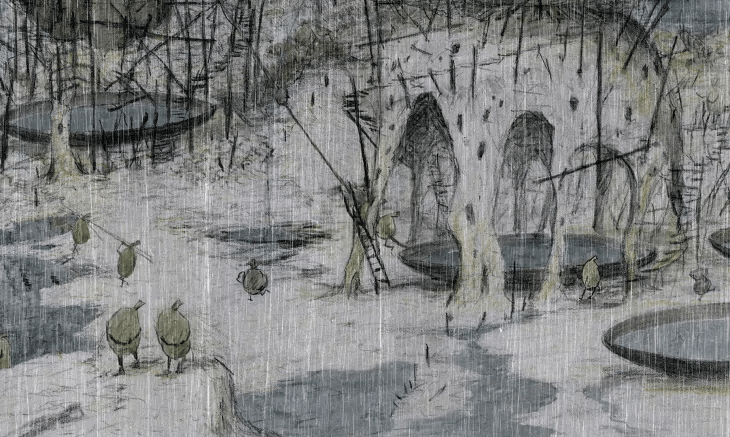
Somewhere between Seuss and Bosch—a journey through imagined landscapes full of people trapped in loops, stuck in traps, or engaged in endless work. Absurdist allegory that seems borderline nihilistic, although I’d be lying if I said I had a solid interpretation of it overall. Some of the metaphors were clear, but others sailed by me; the rough-hewn illustrations and the fantastic score and sound design were enough to pull me back in whenever I started to drift. The lack of dialogue in favour of title cards helps contextualize some of the more obtuse imagery while still keeping things wide open to poetic interpretation.

Certainly an imaginative film—if it’s even fair to call it a film, it doesn’t seem especially interested in cinematic language, pulling more from illustration and mixed media to create its mood. Animation doesn’t have to be filmmaking, after all, it is its own medium with the flexibility to pull from so many other visual traditions. But I guess that’s a whole other can of worms.

The Empty Man

An ambitious jumble of ideas and influences, some well thought out and others pretty half-baked, but executed with a whole lot of skill regardless. The (very) cold open and the scenes with Root are by far the most engaging; the procedural is a bit rote even with all the weirdness around it. Some of the images, though, especially the sequence at Elsewhere, flames tentacling into the night sky… I can see how this has attracted a cult.

Folks seem to be calling out the creepypasta elements like they’re inherently a bad thing, but I’d happily read the whole Pontifex Society wiki if it were posted somewhere. Candyman + Crowley + Creepypasta + Cults makes for an interesting blend.

The Timekeepers of Eternity

Certainly an interesting project. It’s a snappy edit, finding a solid Outer Limits episode in a much-reviled miniseries, and the unusual technique heightens the film’s themes, adding some interesting depth. Where I stumble is in whether it is its own film or something closer to a fan edit, or whether that matters.

If you go by sheer labour, then it isn’t hard to argue for it as a standalone artwork. If you go by originality of the narrative, it’s an edit. Is it transformative? Does it matter? The fact it prompts those questions is enough to make me glad I watched it.

Regardless, it’s easily the best film version of the Langoliers out there right now, so there’s that.