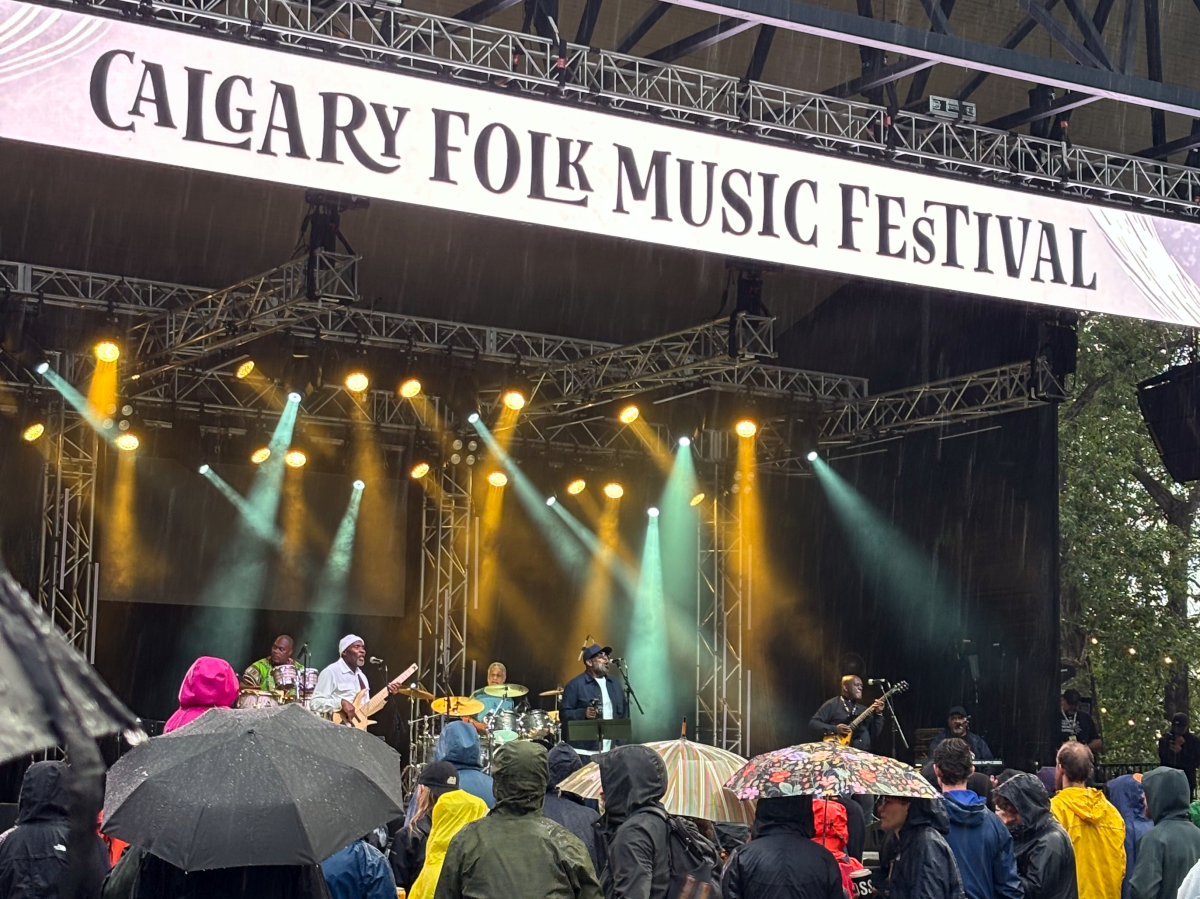
Originally published in the 2025 Calgary Folk Music Festival program guide. This version has been lightly edited and revised.
The joy of instrumental music has been largely forgotten by the musical mainstream.
Pop has always favoured the vocal, but there was a time when the charts at least occasionally made room for songs that were unburdened by lyrics. Think “Green Onions” and “Classical Gas,” each of which reached iconic status in the 1960s, and which evoke the spirit of that decade at least as effectively as their more verbose peers. “Axel F,” the theme from Beverly Hills Cop, topped international charts in the 1980s, its infectiously cheesy synth riff again capturing its cultural moment.
The Champs’ “Tequila,” one of the earliest chart-topping rock instrumentals (if you relax the definition to allow for its drunken exclamation) has a respectable 134 million plays on Spotify. Not quite Taylor Swift territory, but at least in the realm of Beyoncé. But now, it has been decades since an instrumental has had that kind of crossover impact.
Since 1985, the closest thing to an instrumental at the top of the charts is “Harlem Shake,” which hit No. 1 in 2013, driven by a viral dance craze and Billboard’s then-brand-new decision to count video streams towards a song’s success. Instead, instrumentals have drifted to the fringes, ignored by the masses while thriving in musical niches from post-rock to trance, bluegrass and jazz,
Not coincidentally, the genres that embrace instrumentals tend to be ones that reach for transcendence. Whether it’s the hypnotic repetition of dance music, post-rock’s extended cycles of tension and release, or the intricate, sometimes abrasive harmonic play of contemporary classical and abstract jazz, the best instrumental music aims to pierce through the rational and connect with a deeper level of perception.
Why music is capable of that kind of connection is far from obvious. There’s no rule stating that vibrating a string or buzzing your lips into a tube should be able to bring an audience to tears. There’s no physical law explaining why hitting a stretched-out hide with a wooden stick can make a crowd stand up and shake their hips. Pure music, with no lyrics to point towards a literal meaning, is about as abstract as art can get. But it is also deeply affecting.
There are many theories for why that would be. Humans are pattern-seeking creatures, and music taps into that in a major way, creating and subverting expectations in a manner our brains find irresistible. Despite early speculation that it was a byproduct of other, more useful evolution, there is increasing evidence that music predates and potentially even spawned language. Experiments have shown the profound effect music has on the limbic system, which governs pleasure, motivation, and reward; the satisfaction that comes from tapping your toes in time to the beat has deep biological roots. Rhythm, melody, timbre, and harmony connect to some of the most fundamental parts of our mental experience.
Language, on the other hand, is always a step removed from reality. Words are symbols; they refer and represent, pointing towards truths, but they aren’t the truth itself. Music doesn’t represent; it just is, and the experience of it is something that transcends words.
Which brings us to the irony of writing about instrumental music, of rationalizing something that exists outside of the rational world, of “dancing about architecture” as the old joke goes. Trying to put music into words isn’t just impossible, it’s missing the point of songs—which isn’t to understand them, it’s to experience them. To appreciate music is to be fully present in the moment, allowing yourself to be carried along the eddies and currents of a performance. It’s Taoism in miniature: the song that can be described in words isn’t the true song.
For some instrumental artists, that connection between music and spirituality is exactly the point. Calgary saxophonist and multi-instrumentalist Jairus Sharif started his current journey with the Q4DB series, “a creative therapeutic project designed for physical, emotional, spiritual and cognitive communication.” Since those initial experiments, that project has only deepened. Albums like 2022’s Water and Tools or this year’s Basis of Unity aren’t about meditation, connection and healing, they’re examples of those processes in action, expressed through breath, tone, rhythm and noise.
Yasmin Williams’ albums may not be as explicitly questing as Sharif’s, but the Virgina-born, DC-based guitar player seems every bit as inquisitive in her compositions. Her highly percussive take on fingerstyle guitar has always eschewed traditional songwriting structures, choosing instead to follow the melody wherever it takes her. The songs are inspired by events and locations in her life, expressed through pure mood—and tasteful virtuosity. Originally a strictly solo affair (she still typically takes the stage alone when touring), her latest album brings in no fewer than 19 collaborators, even the occasional vocalist, blasphemous as that may seem. But even in those cases, the vocals tend to recede into the background—the meaning is already present in the music.
If Sharif and Williams fall on the side of the seekers, there are others whose embrace of instrumental music is focussed on deeper grooves, not deeper truths (not that you can’t do both; George Clinton said “free your mind and your ass will follow,” but the reverse can work just as well). There isn’t a more pure example at this year’s festival than Empanadas Ilegales, whose members hail from Colombia, Ecuador, Argentina, and Canada, but who bonded in Vancouver through a mutual desire to make people move. Latin rhythms and psychedelic sounds are all the language they need, their spicy guitar lines and horn licks bypassing your rational defenses to penetrate straight to your motor neurons.
Los Angeles’ LA LOM are equally eclectic, if a little more laid back, pulling from a similar stew of Latin sounds along with vintage AM radio soul, surf rock, and Peruvian Chicha. Still mightily danceable, it’s more the soundtrack to a slow sway, music for wind-swept deserts or twilit tropical shores. If it’s a cliché to describe instrumentals in terms of landscape (dancing about architecture again), it’s only because songs like these are more like places than things; they envelop you, transport you, and leave you wanting to return.
Somewhere between the two poles of instrumental artists you find groups like Toronto’s Badbadnotgood and England’s Cymande. The former came together in Humber College’s jazz school, but found their hip hop-infused approach didn’t fit the school’s definition of “musical value.” Ever since, they’ve straddled the space between heady sounds and body music, striking a balance that pleases seekers and dancers alike. Cymande, meanwhile, has never been a strictly instrumental act, and their socially conscious lyrics and soulful vocals have always been part of their appeal. But they’ve also always known how to let loose with an impossibly groovy instrumental, and tracks like the funky flute-and-bongo-laden “Rickshaw” and the sprawling “Dove” from their 1972 debut are a big part of why they’re now enjoying a well-deserved reappraisal half a century after their underappreciated initial run (hip hop royalty Wu-Tang Clan and The Fugees both sampling “Dove” over the years certainly helped keep the band’s legend alive).
As Cymande shows, you don’t have to commit a vow of lyrical silence to be part of the instrumental club. The point isn’t that lyrics are somehow bad, or something to be avoided at all costs. But sometimes words are simply the wrong approach. And while instrumental music sometimes has a reputation as background noise, muzak, or chill beats to be mindlessly productive to, at its best it is capable of so much more. The charts may have forgotten the joy of the instrumental, but for those who venture further afield, the rewards are beyond words.
 Wander Lines